Showing posts with label Scream and Splatter. Show all posts

Mickey Andrew's Jet Technique


I have had the privilege these past two seasons to coach using this technique and I thought I would share some of the pros and con's of it with my readers.  First off, the technique is nothing miraculous, and many have seen it for years.  I actually have coached with some coaches that have based their entire scheme off of this technique with quite some success.  Some readers on here will recognize the technique being very similar to that of a defense I had researched in the past called the 4-3 Scream and Splatter defense.

Background
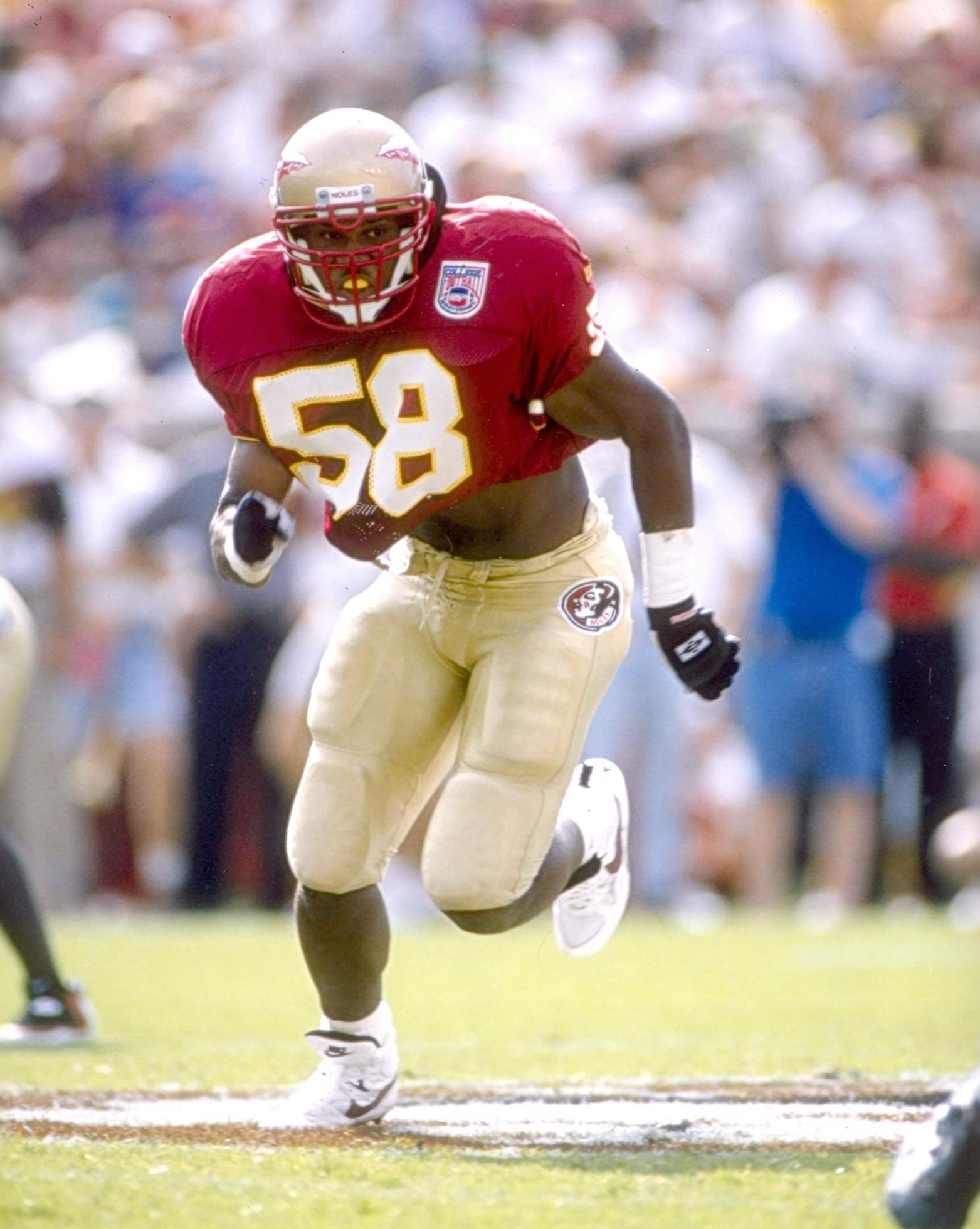
One of the first times I saw this technique was in November of 1996 when FSU beat Florida in Tallahassee, on what would lead to the best revenge game I've ever seen in the national championship game that year.  Florida lost that regular season contest 24-21 and Florida quarterback Danny Weurffel took the worst beating I've ever seen a quarterback take in that game.  Weurffel was sacked 6 times and hurried numerous other times that game by the likes of Peter Bouleware, Reinard Wilson, Andre Wadsworth and countless other Seminole defenders.  I never gave it another thought until in 2005, the team I was coaching was facing an opponent that had it's defensive ends in an odd look.  They were tilted, looking almost in, down the offensive line at a severe angle.  I remember back in the day, the Jimmy Johnson 4-3 guys called this "Smoke", but I'd never seen such a radical tilt by a defensive end.  The other thing I noticed, when watching our opponent on film, was the absolute reckless abandonment the ends had.  They flew in like mad hornets, struck whatever was in their path, ran down plays from behind, and in general, made life miserable for opponents.  The defensive coordinator (DC) I was working for at the time, when asked about this, called it the "jet technique".  He had heard the opposing head coach speak at a clinic a few years earlier on the technique and how it worked.  The more and more I watched it, the more I was absolutely mesmerized by it.  Now, don't get me wrong, our opponent had some cats, they could flat get with it, and their entire defense played with this reckless abandonment.  Anyhow, in the span of 10 seasons, I faced this team at least once every year, only beating them one time.  In seven out of 10 seasons, they utilized the jet technique with great success.  Having had the chance to work with several members of that staff here in the recently, I'm going to elaborate more on how it is taught, it's similarities to regular, block down, step down (BDSD), how not to play the technique and the pros and con's of the technique.  I will also add in how this technique ties into the linebacker play behind it.  A lot of this will not be new, but what will be new is the manner in which the scheme is delivered, by turning loose some of your most aggressive players on some of the offense's weakest players.


The technique
The technique is no different than that of a standard BDSD defensive end.  I had to learn this pretty quickly, as on film, it does not look quite the same.  The reads are basically the same versus the four standard blocks a defensive end will see.

  1. Base block- the DE will attack the near hip and press the blocker back down inside to constrict the running lane and play the spill by the outside linebacker (OLB).
  2. Reach block- the DE will attack the near hip of the blocker and work vertical, to set the edge and force the ball carrier to either cut back, or to "bubble" into the backfield.
  3. Down block- the DE will come flat down the line attacking the first threat to him as he reads down the line to up the field.  This threat could be a pulling guard, kicking out lead blocker, a dive back, or the ball being run away from the DE.  In the case of the ball being run away, the DE is to chase, chase, chase with reckless abandonment in an attempt to get to the football.
  4. Pass block- the DE will attack the near hip, and work vertical to contain the quarterback in the pocket.
Jet vs. base block

Jet vs. reach block

Jet vs. down block


The key component, as with any technique, of jetting, is the footwork of the DE.  The DE must not step up field.   I cannot stress this enough, as if the DE is up the field, he has made the offense's job that much easier blocking him.  The DE must step AT his target.  Even though hand placement, as with standard BDSD, is not critical, the steps, still are.  The DE must step at his target, THEN make his read and adjust his path to the attack point accordingly.  A key item in teaching the DE's feet, is the placement of the down hand when in his stance.  If at all possible, get your DE's to play with their inside hand down.  This will almost naturally force the DE to step into his target.  As with anything that involves technique, the footwork is ever-so critical when teaching jetting.

As you can see, this is all pretty standard stuff.  No real shockers in technique here.  What is the shocker, is what a simple change in alignment, stance and mentality can allow for when it comes to the selection of personnel.

Alignment, Stance and Purpose
The DE assumes a sprinters stance, looking down the line of scrimmage (LOS).  In some cases, the DE is actually parallel with the LOS.  The DE will align one yard outside the EMOL and take this tilted stance.  What this alignment and stance do, is allow the DE to come off like a rocket (we often used to call them "wick lighters" or "bottle rockets"), attacking the blocker at a very high rate of speed.  This makes the defender very difficult to block due to the high rate of speed they can attain.  The more athletic the DE, the wider he can align, thereby making it more difficult for him to be blocked.  The width of alignment also gives the DE the element of time to diagnose the read he is getting.  It also clarifies this read, because of the width of the DE, the blocker has to make a tremendous effort to get to him on the base and reach blocks.  

Jet Stance

The purpose behind all this, is to allow the DE's to play fast and be reckless.  Many coaches having called jet DE's "wrecking balls" or "crash test dummies".  The other purpose behind the technique is that it allows a smaller, quicker athlete to play the defensive end position.  Not everyone is blessed with 6'2" 220 pound DE's in high school.  I have seen DE's as small as 160 pounds play this position with great effectiveness.  The key element with this technique, is the selection of the player to play this position.

Player Selection
The jet DE needs to be some of the names I've mentioned above, such as "wick lighter", "wrecking ball" or "crash test dummy".  They need to be relentless, have zero fear of contact, and understand their role within the defense.  They must be a player that knows, they may not get very many tackles, but that they will get to make contact on just about every play in the game.  The DE must relish contact.  He must not shy away from it, and as many have said, he must be the "bull in the China shop".  Our opponent for the past ten years, has utilized extra wide receivers, tight ends, and even running backs that weren't labeled as "offensive players" to fill this role.  They all shared the above traits in that there was a universal love of contact.  A lesser athlete can pay this technique, but it does need to be modified a bit by tilting the DE more parallel to the LOS and playing him a bit closer to his read, so that he can close the edge a bit better on down block reads.  

Pro's and Con's of the Jet Technique
The pro's of the technique are as follows:
  • It allows for smaller, quicker players to play defensive end in a four man line.  How many times have you heard a coach switch to the 3-3 or the 3-4 because "we just don't have that many defensive linemen (DL).  Jetting, allows the smaller quicker player be effective, so long as they like contact and are not selfish.
  • The smaller, quicker player, coupled with the wide alignment makes the DE very tough to block.  You can almost count on not reach blocking this player with an offensive tackle, and even tight ends (TE's) have trouble with them.  Their head of steam coming off the ball, coupled with their quickness usually stones lead blockers coming from depth, even if said lead blocker outweighs the DE.  You can try optioning off of them, but the quarterback is usually going to pay because of the ferocity at which these DE's come off the football.
  • The reads are very simple, and are a visual key, rather than a feeling key (the way BDSD is).  For years, I've had trouble with the DL getting their hands on a blocker to be able to "feel" the blocking scheme.  The jet technique plays right into what kids use most, their eyes.  The DE doesn't have to feel what the blocker is doing, he gets to see it, then attack it.  By playing into what most high school players already utilize the most, their vision, it allows them to play fast and aggressive, as they trust their reads.
  • It is easy to teach.  You can literally teach the technique and reads in one practice session.  The key is continually repping the fits of the various blocks.  The other key is breaking any selfishness by a DE wanting to "make a play" and not stay within the scheme.  
The con's of the jet technique are:

  • It exposes linebackers (LB's) to down blocks.  This point is argumentative, but I bring it up, because it is the largest flaw I have with the technique.  Since the DE does not get hands on the blocker, the blocker gets a free release to a linebacker.  Now, if it's the OLB, this block is very tough, however if it is the middle linebacker (MLB), then this block is executed quite easily.  The argument here by the proponents are that because the DE "wrecks" shop in the backfield and spills the ball laterally, it allows time for the MLB to get off this down block and pursue the football.  I'm sure this could be debated for hours, but this is my number one gripe with the technique.
  • Lesser athletes struggle playing the position.  In my opinion, you need some pretty athletic DE's to play this spot.  They need to be able to see the read and redirect on the run.  Some kids I've coached, quite simply do not have the natural ability to do this.  If they do not, you can adjust the stance and the alignment some, but not to the point that it is as effective as if the player was a very good athlete.
  • It requires an absolute desire for contact.  In this day and age of the "softening football player", it may be hard to institute this technique because the player must be willing to sacrifice statistics for the love of contact.  Many players we get, simply don't like this, and are very hard to break of their selfishness.  The other thing, is that if they are soft on contact the DE will not be in a great position to constrict running lanes on base blocks, or spill the ball on down blocking gap schemes.  
Jet Technique Coupled with Linebacker Reads

Again, none of this should be Earth shattering, but all of it, is very fundamental in teaching the reads and run fits of the four man front when utilizing the jet technique.  Looking at the reads, from the four reads given above, the LB would react as follows:

  1. Base block- the way I have taught the technique, to keep it simple is if the DE is outside with his read, the LB is inside with his.  If the DE is inside, the LB is outside.  So versus the base block, the DE is attacking the hip and constricting the inside run lane and is outside, so the LB must fit inside this block into the open gap the offense is presenting.  
  2. Reach block- the reach is taught similar to the base, but once the ball has declared itself out of the LB's open gap, he is free to scrape and chase the football outside where the secondary run support should be turning the ball back into both the DE and the OLB.
  3. Down block- on the down block, the DE is inside, so the LB must gap exchange and now be outside.  The LB will scrape and replace the DE, as the DE spills the block, or tackles the dive back.  Again, nothing new from BDSD, other than how the DE attacks the blocker.
  4. Pass block- obviously here, the OLB would read that the OL is pass blocking, and will now get into whatever pass drop the coverage the defense is in would require.
LB reaction vs. base block on DE

LB reaction vs. reach block on the DE

LB reaction vs. down block (note how exposed the MLB is on this play)
Conclusion
In conclusion, I think the technique has merit.  However, I think you have to have the right folks to run it.  You have to have some absolute wrecking balls at the DE position, that love contact and are not selfish players.  As with any technique it must be taught properly as well.  Improper technique will lead to the DE being out of position which, in turn, leads to huge holes created in the defense.  If properly taught, with the right individuals playing the technique, one can have some very good success using Mickey Andrew's jet technique.


Duece

Defensive Line Play-"Running the Circle"


Yep, it's just that simple...

Keeping with the theme of defensive line play, let's look at how a defender should wrong arm a kick out block.  Whether this block is from a pulling guard, H-back, or a fullback, it does not matter.  The elements of being able to execute gap exchange are essential for those choosing to use a gap scheme defense.  As with anything, we will look at history first and then describe the technique itself. 


History
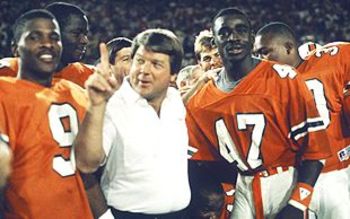
As with most of my stuff, none of it is original.  I have a dear friend who played defensive line at a some small colleges in the Midwest and he learned this technique and he passed it on to me.  As I've gotten into writing and discussing my philosophy, techniques, and videos, people have asked me about how I teach the wrong-arm technique.  Wrong-arming, or "splattering" as we referred to it at my last job, is not a new technique.  The good ol' boys at Miami back in the mid 80's put the offensive world on its ear when they developed this technique, and all but eliminated the triple option from existence.  Gap exchange was born, and the technique spread throughout the land like wildfire.  As with any technique and how it spreads, the more diluted the technique gets, from the original inventor, the more different things become.  Not to say this is bad, as I think many coaches have been able to put their "spin" on techniques to make them better, so this "dilution" is NOT a bad thing.  As a matter of fact, this dilution is what led us to the topic of this very post!


"I knew we were up to something good!"

When I first encountered wrong-arming it was in college, and boy was I startled by it!  Being an offensive lineman, and pulling down the line only to have your legs taken out from under you was quite different than what I was used to in high school.  The way it was taught by the defensive coordinator where I went to school, was for the defensive lineman to attempt to cut the blocker in half, or essentially cut the blocker down.  This served to create a pile, and an absolute mess in the backfield.  So, as my experience playing, eventually led to coaching, this is how I started to teach the wrong-arm.  Nothing wrong with this at all, and for years I had some success doing so.  Until one day, when I went to a small local clinic, and even though I wasn't paying much attention to what the guy was talking about at the clinic, I do remember he made the comment "Never trade one-for-one, always play plus one on defense".  I've never forgotten this, and to this day, it's is very much a part of my defensive philosophy.  Never did I know it was going to tie into how I was coaching my defensive linemen.


Later in my coaching career, I coached with a guy who is literally the best defensive line coach I know.  He doesn't know much "big picture" stuff, but when it comes to actual defensive line play technique, I'd be hard pressed to find a better coach on the subject.  Well, for six years he was my defensive line coach, and he introduced me to the topic of "Running the Circle".  He was taught this where he played college football, and he explained it to me, much the same as the clinic speaker did.  Never trade one-for-one.  Running the circle keeps the one-for-one from happening.  When you cut the blocker, or simply "stone" the blocker, you have effectively traded one-for-one.  When you run the circle, as you will see, you now are back to "plus one" for the defense.

Running the Circle
What does this technique involve?  Quite simply, it's wrong-arming, but taken one step further.  When the defender has recognized the kick out block and is going to wrong-arm the blocker, he will attack the inside, or up field breast plate.  Now, before I learned this technique our aiming point was the up field hip.  Not any more, we don't want to cut anyone and we want our defender in a position to still be able to make a play.  As the defender runs through his aiming point, he attempts to elevate the breastplate of the blocker.  The defender does this by accelerating on contact.  By attacking only half of the blocker, this begins to turn or "spin" the blocker in place.  Effectively you have still wrong-armed, or gap exchanged, even though you've not created a huge mess, you are still closing gaps with bodies.  As the defender continues to accelerate and spin the blocker, he should attempt to completely turn 180 degrees from his initial contact angle.  This is called "Running the Circle".  The video shows the technique better than I can probably describe it however. 


DL Play - Running the Circle - Deuce and OJW from Barry Hoover on Vimeo.


The idea here is that the blocker is now neutralized, as he's only getting half of your defender, and your defender has still effectively exchanged gaps.  Secondly, the defender is still on his feet, and by making the 180 degree turn, he can now do one of two things.  The defender can either help chase down the running back who has spilled outside to the primary force player, or he can fall back in on the running back who has been caged in by the primary force player and is trying to cut back.  One immediate area I saw instant results with this technique was that every now and then we had the GT counter (counter trey) cut back into the playside A gap for big gains on us.  Not often, but when it did, sometimes it was quite deadly.  Once we installed this technique as our base technique for wrong-arming, we never saw the cutback hurt us again on the counter. 


Running the circle can also be utilized by the interior defensive linemen as well.  Basically any lineman that is executing gap exchange and wrong-arming does this technique for me.  As you can see in the video, the technique makes life difficult for opposing blockers.  Offensive coaches don't mind trading one-for-one, but one-for-none is what they get when you teach running the circle.

So as you can see you are now playing defense 11 on 10, which is what you want.  Again, you want to be "plus one" in every way you can when it comes to defending offenses, and the running the circle technique allows you to do this.

Duece

The 4-3 Scream and Splatter


I came across this defense, by sheer accident (which you may download here) several years ago while helping a friend.  I had a phone call one evening from an old college friend who was the head coach (HC) and offensive coordinator (OC) at a small school in Southwest Florida (SWFL) and was facing a team that had an ultra-aggressive 4-3 defense.  He sent me some film on them, and was trying to figure out how to attack them with the split-back veer.  After watching several films on this opponent I was very intrigued to see the radicalness of the defense.  The interior tackles sat in 2I's most of the time, and the defensive ends (DE's) were in a radical tilt, almost ninety degrees to the traditional way of aligning.  The DE's looked right down the line of scrimmage (LOS) to the ball.  The outside linebackers (OLB's) were stacked right behind these ends at about four to five yards off the LOS.  The middle linebacker (MLB) was the same depth and directly over the center.  The DE's were the kicker though, they came off the LOS like missiles, and simple put, wrecked everything in their path.  It was quite astonishing to watch, and I could see why my friend was calling, as they were a very rambuncious bunch to try and move the football against.  The secondary seemed to be playing some sort of two deep man under coverage, maybe even a version of quarters.  The corners appeared to be in man with the safeties twelve to fifteen yards deep, and rocking back on the snap.  They would rotate the secondary into cover 3 when they got trips or twins, they never broke the box, always keeping their 4-3 intact.  The defense was aggressive and attacking in nature and they, simply put, got after your ass! 


The conversation, and films led me to try and research the defense, however, information was not easily obtained.  One day when posting on the Huey board, I had a coach, from Wisconsin respond to me and tell me about a "tilted 4-3" in their area that was similar to the defense I had been describing in my posts.  He told me to check out Lancaster High School, in Lancaster WI.  So I gave their head coach a call, and he directed me to their defensive coordinator (DC) who was very helpful.  He sent me information on the defense, and told me they got it from somebody out in California.  He did not elaborate but we spoke several times about his defense, the pros, the cons etc.  Over the years, from my first post about the defense, people have contacted me and asked me about it.  I wanted to put a post out here that some may use, to get a first-hand look at this defense.  I want to preface, I did not run this defense, I merely took some things out of it, that I will discuss later.  I am going to break down the defense from the ground up, and then go into what I used out of each section.  Hopefully this will shed light on a very aggressive and attacking 4-3, that some have never seen.  Shall we?


Defensive Line
In the Scream and Splatter (S&S) defense, all 4 of the down linemen are tilted at a forty-five degree angle to the LOS.  The basic shades are your standard over front shades with a one and five techniques to the weakside, and a three and nine technique to the strong side.  The defense I saw on film, did not do this, they had 2I's in the interior, and the strong end played a seven technique (inside shade of the tight end).  The reasoning behind the tilt is to better facilitate our old friend, block down, step down (BDSD).  The author of the defense explains that this allows them to execute the "splatter" technique against gap blocking schemes.  As far as defensive line manuals go, this one is not much different except for the tilt.  I got some film on Lancaster, and they are not your "war-daddy's" by any means, but they do get after it.  The main reason is the simplicity in the teaching of the defensive linemen (DL).  They key their "trigger" as it is called and react from there.  After that, they have the normal reactions to the blocking schemes that you see most four man front defenses doing these days. 


The other key for the DL is the actual "splatter" technique.  This is practiced daily, and there is a diagram in the packet they sent me of how to set up the splatter drill.  The interesting thing is they do not talk about depth or angle, they simply talk about getting off the ball, and coming down the LOS and attacking the upfield armpit of the blocker.  The diagrams basically speak for themselves, so I will not elaborate further.

I did not tilt all four of our linemen, the number one reason is that we were seeing so many zone teams, I felt it would allow our inside guys to be reached too easily.  I did tilt our DE's, but not radically like the SWFL team mentioned earlier.  We simply put our inside had down, and then turned our body inside enough to see the football.  I actually changed our term wrong arm to Lancaster's term splatter and it's quite a funny story.  In my first year as a DC at my last gig we were teaching kids the wrong arm technique when I overheard one young player tell another "why are we learning this, if it's the wrong way to do it".  Ahh, the teenage mind!  So, after that, we decided to call our wrong arm, the splatter.  The kids liked it, it made sense to them, and the rest is history!


"Gnarly dude"

Linebackers
The linebacker play in the S&S defense is what really caught my attention.  The way they taught it, seems overly aggressive, yet there was an effectiveness to it, that I bought in to.  All three linebackers (LB's) read the fullback, or near back in offset backfield sets.  The LB's had but one read, intersect the path of the FB.  That's it!  All they had to do, was to intersect that path, and leave the rest to the safeties behind them (we'll talk of that later).  This made for a defense that looked as though it was blitzing every down.  The LB's seemed almost a step ahead of the opposing offenses on film.  It was quite a sight to watch.  Now, I know what you are thinking, "Why not just run counter?".  You would be right, but the safety play behind it, made this nearly impossible.  The LB section shows the drill on how to teach the LB's to intersect the path of the fullback.  They set up trash cans and ran through all the various series of plays, and how the LB's should react to these (they called it the "Barrel Drill").  The other interesting thing is that they involved the safeties in this drill as well.  As you will see in their run fit section, this safety involvement is critical to the defense.

We took the basics of this read system and used it, however we added a few other things to it to help us with the counter runs and bootlegs.  Our MLB, had these exact reads, but our OLB's had a few other things added to it.  I also started using our safeties in run fit drills, and in inside run drill.  This payed huge dividends as it allowed the safeties to see just where they should fit, with out having to worry about the pass threatening them. 


Defensive Backs
The safeties were the crux of the S&S defense.  They were the "clean up" guys.  Basically, they made the LB's underneath of them "right" by fitting where needed.  Now, the S&S isn't for the faint of heart, as they sit in cover 0 all the time.  Yep, that's it, one coverage!   As you can see, they wanted to keep things simple.  So, back to the safeties and how they "fit" into the defense.  The safety on the action side of a run play, was no different than your quarters or 2 read safety in that he was the force player.  The backside safety was the kicker, he had to clean up all counter, bootleg, and reverses.  The backside safety made the LB furthest away from action, be able to "scream" to the football without fear of the cutback or the counter.  This was important because it led to the defense outnumbering the offense at the point of attack (POA).  This is exactly how I played it out of my 2 read/Blue coverage scheme as we've read before (go here if you haven't already). 

The corners in this defense are primarily man to man guys.  In the playbook you can see that they gave the corner 6 basic reads and worked those to death.  I've often had this philosophy myself, corners have a tough enough job, no need in worrying them about the run.  Well, the S&S is perfect for your cover corner. 


The S&S in Recent Years
I have not had the luxury of talking to Lancaster's coaches in over 3 years now, however the last time I talked to them, they were having some problems with spread formations, most notably 2x2 teams that ran zone read.  I have no doubt that they have come up with  a scheme to defeat these offensive tactics in the recent years, as many on the Huey board have said they still remain an elite team in Wisconsin. 

In Florida, my buddy tells me nobody runs the defense that got my interest started all those years ago.  It's a shame, as the coach that ran it, according to my friend had a very impressive record to go along with his defense.  Nonetheless, the defense has gone the way of the Dodo bird in that particular area.


I hope this was insightful to those who have been asking about the defense.  I think the S&S has excellent merits, and is a sound system that seems very simple to install.  I know it caught my eye when I first saw it, and I definitely stole all I could from the information I gathered on the S&S.  Please feel free to email me about this topic, however, please remember I did not run this defense in its entirety, only select portions.  Here is some footage I got from Lancaster, sorry about the cutup quality, I had to cut it myself.  Enjoy!


Other Happenings
Coach Hoover has a GREAT article on "How Much to Install".  He's a man after my own heart, especially linking to the great Tony DeMeo.

Football-Defense has a very good article on the basics of Turning a Program Around.  Very good read, and a very good site, I must say.

Over signing won't ruin the SEC, writes Chris Low in his ESPN blog.  Something tells me he's right, and I love Steve Spurrier's quote at the end of the article.  The Ol' Ball Coach is still a hoot!


Duece