Showing posts with label linebackers. Show all posts

Two Gap, One Gap Defensive Line Revisited


I'm not sure any one post I've ever written has generated as much email, both pro and con, in my inbox.  What is amazing to me, is the lack of understanding folks have for this concept and technique.  What I'm going to do today, is revisit the original post and look at Two Gap/One Gap (TGOG) from the perspective it was meant to be run from and that was helping the 4-3 defense to defend the spread offense.

Purpose
TGOG was developed as the shotgun, power run game came into effect in the landscape of college football.  As we all know, when facing doubles, in the 4-3 defense, generally both outside linebackers (OLB's) will have to walk out and honor each of the two receiving threats to the outside of the defense.  If not, the defense stands to become outflanked.  Enter in today's offenses that mix zone and power runs with fast, or bubble screens, or even down-the-field passes and you have a tremendous need for the OLB's to be able to play outside of the box.  There are many answers to having just a five man box in the 4-3, and one of those answers is TGOG.

Remember, when walking both OLB's out of the box in the 4-3 you are now playing to the offense's hand if you keep your defensive line (DL) in their respective gaps.  There are potentially six offensive blockers, which means there are seven gaps and you only have five immediate bodies there to help.  Even if you counted the OLB's in the fit, you end up cancelling them out because by alignment, they are in the same gap as the defensive ends (DE's).  Something has got to give.  Enter in TGOG which actually fits the pieces of the defense right into where the offense is attempting to run the football.  Because of this fit, the ball is pushed directly to where the offense doesn't have good leverage with its blockers.  By using TGOG you can now add the OLB's back into the count of the run fit, because, even though displaced, the defensive reaction is setting them up to be in the proper gap.

OLB's displaced from the box


In my original posts on TGOG, I drew it up against two back, power run game.  It can be used against these offenses, but the technique is at its best when attacking one back zone run teams.  The technique doesn't do too bad against one back power run game either.  If using it as a base DL technique, the only issue that needs to be guarded against is the three technique getting washed down inside on double teams.

The Basics
As you remember from before there are rules to follow for this technique.  On each snap, depending on the front, the DL has to figure out what kind of player they are (i.e. am I a two gap player or a one gap player).  The rules are simple, if your alignment puts you next to an open gap to your inside, you are a two gap player.  If your alignment puts you next to a gap that is already occupied by another DL, then you are a one gap player.  So, looking at the traditional open sets of 10 personnel, with the three technique set away from the running back (RB) in the shotgun, you can see, by alignment, the 3 technique (T) and the weakside DE are the two gap players.  The gaps to the inside, or in towards the football (center of formation) is open.  By rule, these players are now two gap players.  The remaining two players, the strong DE (A) and the Nose (N) are one gap players.  The Nose gets people confused because they feel like because the gap "inside" of him would be the strong A gap is open, he too would be a two gapper.  This is not the case.  The Nose is taught, early on, that if aligned in the A gap, he's a one gap player.


Many folks have been confused by this, thinking that there will be one two gapper and one one gapper on each side of the formation, and this simply isn't true.  Looking at the set up for 11 personnel and you can now see to the tight end (TE) side of the formation, you actually end up with two players that are two gapping (both the Tackle and the DE).  On the open side, the set up, is of course, the same as it would be for 10 personnel.  For me, the weak side rarely changes because I do not line up my weak DE in anything other than a five or a seven technique.

Fronts can change assignments.  If you look at the two illustrations below, the Indian and the Outlaw fronts make a difference as to what the DL is doing.  With the Tackle and Nose in 2I techniques (Indian), both of those players are now one gap players, while both DE's are now two gap players.  In the Outlaw front (both the Nose and Tackle in three techniques), the Nose and Tackle are now two gappers, while the DE's are one gap players.  Again, it is quite simple to determine who has what, by following the alignment rules.


Stance and Alignment
I get several questions about this as well.  I don't have a great answer for a lot of this, because it really depends on what kind of player you have where you're at.  Where I coach at now, we've got one hell of a DL, so we don't really change our alignment much when we run TGOG.  My last stop, however, yes, we had to change our alignment a bit for our guys to get the job done.

The one gap player, if anything, needs to align just a bit wider than he normally would.  For an interior DL, this doesn't matter as much as it does the DE.  In some of the fits, the DE will actually be the guy setting the edge, so he'll need to be in a position where he doesn't get reached.  Getting reached is the number one cardinal sin for the DE, so he will need to align where this cannot happen.

Difference in alignments of a one-gapper (DE) and two-gapper (DT)


Technique- The One Gapper
The one gap player is a very simple technique.  They are rush players.  Getting up the field is not an issue for them, even against the trap game.  Now this is not to say that they are so far up field they cannot defend the run, or they are creating a gap by their depth.  No, the idea here, is to get off the football, get up the field and find the ball.  Once this player reaches ball depth, they should set their feet and begin to play off the block they are getting.  The main two focal points for the one gap player, is to not get reached (if this requires the player adjusting his base alignment, then do so), and get off the football.

Varying angles of attack by technique.  Two-Gapper (T) attacks the outside eye to center of defender, where One-Gapper (E) plays outside using an "escape" or pass rush mentality.


Technique- The Two Gapper
The two gap player is more of your traditional, block down, step down (BDSD) type player.  This player's main concern is winning the stalemate battle with the offensive lineman (OL) over him.  The idea is to treat this just like the King of the Boards (KOB) drill.  The two gapper is not concerned about getting reached.  If this player gets reached, he's done his job, because his gap is actually the gap inside of his base alignment.  Many folks have confused this technique for a stunt, and THIS IS NOT THE CASE.  The two gap player, will play the inside gap from an outside alignment.  Against a base block, this player will work the blocker backwards until the ball declares, then, and only then, will they work into the inside gap.  Against a reach block, the defender simply allows himself to be overtaken (this should be pretty easy for the OL since the two gappers usually align in a tighter shade than normal).  One of the real benefits of the two gap technique is that of how it handles the down block or scoop block.  Because the defender is in such a "heavy" alignment this makes it very difficult for the down blocking OL to climb to the second level, thereby protecting the LB's.  Second, it puts the two gapper in a great position to spill any trap blocks by pulling OL.  On a pass set by the blocker, the two gap defender will bull rush, then rip under and work into the inside gap.


Linebacker Techniques
The LB techniques don't change all that much from traditional ones except for that of the inside linebackers.  When played from a 4-3 set with both OLB's outside the box, the MLB will use what is called a "fast scrape" technique.  It's called this because the MLB does not care about the cutback.  All he cares about is the angle of the ball, whether it's split zone, or gap runs and what side he's supposed to attack.

Against the split zone stuff, the MLB reads the block of the center.  If the center sticks his nose into the 2I, then the MLB jumps the front side A gap, because the center cannot cut him off.  If the center leaves the 2I and immediately climbs to the Mike, then the Mike sits and will actually allow the center to push him right back into where the ball if being forced to cut back to which is the B gap underneath the guard.  The guard should not be able to handle the one-gapping Nose because he's getting off the ball so hard (remember he's "rushing" not reading).  The guard pushes the Nose into the path of the RB, forcing him to cut back right into the MLB who is being pushed right back into the new path of the RB.  If the back continues to wind the ball back, he'll end up running into the unblocked DE.


Against runs that are full flow type runs (two backs in same direction), the MLB will fast scrape with either two-gapper depending on what side of the ball is being attacked.  Outside zone is a full flow run that when run at the 3 technique the MLB will fast scrape to the outside hip of the two-gapping Tackle.  The Mike takes a flat angle to the ball and if the ball has declared beyond the B gap, he will continue to pursue the ball inside-out.  The center will have a very difficult time getting to the MLB here in this situation because of how lateral the LB is.


If the play is being run to the weak side of the defense the Mike will scrape one gap wider to the outside hip of the two-gapping DE as shown below.  On paper, it looks as though the guard has the angle on the LB, but as long as your LB can rip across face he should be able to scrape to the outside hip of the DE.  If the LB gets reached, it is not an issue because the one-gapping Nose cannot be cut off by the center and will end up in immediate pursuit of the ball unblocked.  The force player can box the lead blocker back (who this is depends on coverage) to the chasing Nose who overtakes the two-gapping DE and can replace the LB if he gets cut off.


MLB gets cut off, Nose replaces in the fit, defense is still +1

Against split flow gap runs, the MLB keys the pullers, and again, has the same scrape aiming points.  This is all based on the fits by the DL and whether they are two-gapping or one-gapping.  If running a counter play to the three technique the offense has the difficulty of trying to double the three to get to the Mike.  As shown below, the two-gapping Tackle drives into the guard forcing a bubble in the offense.  The OT is forced to double to help get movement to get the lane cleared for the BSG to pull through.  The two-gapping technique allows the MLB to scrape off the hip of the Tackle and spill the second puller in the counter gap scheme.

Vs. counter gap to the open B gap side, the MLB simply scrapes one gap wider, again scraping to the outside hip of the two-gapping defender.  His job is still the same, spill the second puller in the counter gap scheme.  This allows the Mike to play fast, as with repetitions and seeing the guard pull, he knows where he  needs to scrape to in order to be in the correct position for his fit.

I get many questions about Power Read or Inverted Veer as well.  Again, just follow the rules listed above and defend the play.  The MLB's rules and fits do not change with the play, he's reading flow type and looking for pullers, then scraping to his fit.  In the case of Inverted Veer, he will scrape to the outside hip of the two-gapping DE and spill the lead blocker out to the OLB or safety (or both depending on how the coverage is set up.  The two-gapping DE also forces the offense to show its hand by forcing the give read to the sweeper.  The DE plays so heavy of a technique the OT cannot get out from underneath him to cut off the running MLB.  Also, many times the offense motions the sweeper back into the box, which adds another player, the OLB to the side away from the offset back that now can also get into the cut back fit if the offense were to fake the sweep and call the QB  keep automatically.

The OLB's are very rarely called into action to fit to an inside gap because of the two-gapping technique.  There are some situations that have the OLB to the Tackle's side of the defense that will have to scrape into the B gap, but due to the two-gapping technique by the Tackle it allows the OLB to be late getting there.

The OLB's run fits are very simple when it comes to where they should be.  Again, they have to know whether they are working with a one-gap DE or a two-gap DE.  The OLB to the two-gapper side has a perfect fit, because all runs will be spilled out to his side.  On runs away, or split zone looks, the OLB scrapes to the outside hip of the DE, replacing the DE and playing the QB on option-type runs.


Against a gap run at the two-gapping DE, the ball is spilled outside to the OLB.  In all actuality, the true fit is that the DE spills to the MLB who boxes to the DE and spills to the OLB.  Either way, the ball will bounce outside to either an unblocked OLB or an unblocked safety, depending on how the coverage is set.


When working with a one-gapping DE, the OLB will fit inside hip of the DE.  For some sets, this can make for a long run by the OLB, but the technique of the Tackle also helps delay the gap declaration because how he plays his two gap technique.

Setting the Front
I also get some questions about how to set the front when using TGOG.  I prefer to set the front away from the offset back.  The main reason is that with the three technique away from the back, the zone runs are tough on the OL and the gap runs, where the offset RB is the lead blocker, get spilled outside by the two-gapping DE.  I'm not saying that you can't set the front otherwise, just simply follow the rules for TGOG and you will be sound against whatever it is you're defending.

Some fronts that present both a two gapper and a one gapper on each side are illustrated below.  These fronts, with either two, 2I's or two 3 techniques change the dynamic of how the offense will attack the defense and keeps the opposing OC guessing as to what you're doing with your front.  With, what I call Outlaw, or 33, the two 3 techniques you get two, two-gapping DT's and two one-gapping DE's.  This front is very good for the zone teams that like to find your 3 technique and then flip the back so they can run zone opposite of him.  Well, don't give them a three technique to attack, give them two!

Outlaw or 33 front
Indian or 11 front
One of my favorite fronts was the two 2I's, or what I called Indian.  What I liked about this front was, you can essentially turn loose your DT's to wreck havoc and it takes the OL three guys to block two.  This keeps the MLB free to scrape C gap to C gap.  The two, two-gapping DE's spilled any gap runs outside to the scraping MLB and the OLB's.  This works great against teams that like to run QB zone or QB Wrap from empty or two-by-two looks that force both OLB's out of the box.  You are pushing the ball out to these players, making the player's job easier to defend both the run and the pass.

Conclusion
I'm hoping this will help to set the record straight on some issues.  This really is a simple technique that can vastly reduce the stress on your OLB's when having to be displaced from the box due to spread sets.  It can be used against two back run game, but is better suited to defend the one back spread run game.  What I really love about the setup is the fact that TGOG attacks gap runs as effectively as it does zone runs.  No need to guess what your opponent is going to run, or get caught in a bad defense, because TGOG is set up to defend both.  TGOG is set up to push the ball where the defense has an unblocked defender, which should be the goal of ANY defensive scheme, not just TGOG.  Again, I'm hoping that this post will shed some light and give clarity to what a good scheme TGOG is.

Duece
A Safer Way to Play Quarters Coverage


In all my years coaching this coverage, the number one question that arises is "How is my OLB going to run with a wheel route?".  It happens a lot where I coach at, because the post/wheel route concept is the single most popular concept around.  It was made legendary around here in the early 80's when a local team made several playoff and state championship appearances, with the post/wheel concept being their top concept from a twins formation.  Anyhow, around here, you need to have an answer for this question, or you're going to be in some serious trouble.


Originally, my adjustment was to play 2 read to two detached quick receivers.  This was a great solution, and I've written in length about 2 read, and using it as an adjustment to Quarters coverage.  However, at my last the talent pool was as dry as I've ever coached in.  I still wanted to play a pattern match coverage, but the boss man detested the OLB running with the wheel.  I also didn't have a lot of time to deal with to install multiple coverages and checks to various formations.  What I needed was a coverage that would defend well over 90 percent of what we were going to see.  Well, here's what I came up with, and I'll share with you the differences between standard Quarters, and my version.

General Rules
For the safeties, my Quarters was the standard stuff.  Everything in this coverage was based off what the number two receiver did.  Also, the safety and the corner worked in tandem, not by reading number two, but by communicating what they were seeing their respective receiver doing.  I figured, most of our guys were coming out of youth football where they had played man-to-man coverage, so their eyes were used to being on their man (or in poor cases, the backfield).

What did number two do?  In this case...had a drink!

I taught that the number two receiver could do one of four things, and they are listed below.  One unique thing I taught, was our safeties eyes would follow the number two receiver to his next threat.  I got this from talking with a college coach at a clinic a couple of seasons ago and I really liked it, because it naturally makes sense.  Here are the four reads and reactions we taught our safeties:


  1. Go vertical.  If number two goes vertical (depth based on game plan), then the safety would lock on man-to-man.  Standard, 100 percent Quarters stuff right there.
  2. Go out.  This was the only route the safety had to make a call on.  The safety would make a "wheel" call to the corner and the OLB to announce that number two was not vertical and was now threatening the flat area.  When number two was out, the safety got his eyes to number one, and was purely a robber player.  I told them this "Eyes to one, rob curl to post".  That simple.  As you can see, the safeties eyes follow the number two receiver to his next threat.  The number two receiver is out, so the safety's eyes follow him to number one.  At this point the safety is in a good position to break on a route coming into the curl area, or work underneath a post route.
  3. Go in.  If the number two receiver worked inside off the snap, the safety would follow him with his eyes to the next threat, which in this case is the QB.  The safety would now slow pedal, reading the eyes of the QB.  Usually when the number two receiver drags inside, or slants inside, you're getting a high-low concept, such as post/drag, mesh etc., or you're getting double slants.  Again, the safety is in good position to play these routes by reading the eyes of the QB.  The corner will alert the safety as to what route he's getting so the safety will know how to react by either speed pedaling to work under a post, or driving up on a slant cut.  I'll discuss the corner technique at length later.
  4. Block.  I won't discuss run blocking at the moment, because to be honest that horse has been beaten to death on this site (lol).  I'm talking about pass blocking.  In the case of spread offenses this may be a TE or H-back that's been left in to block, rather than run a route.  In this case, the safety's eyes go to his nearest threat, which again, is the QB.  The reactions when the number two receiver block are the same as when number two is inside.
Safety reads vs. #2 out

Safety reads vs. #2 in

Now, depth of these routes are all based on game plan.  In some cases, I've had the safety jump that drag route with a call.  These are just the general rules of our coverage.  Nothing really ground breaking here, except for the teaching of the safety's eyes.  I had never really heard anyone discuss where the safety should put his eyes if number two didn't threaten him vertically.  Now on to the corners.


The corners reads are the biggest change in my version of Quarters with the old standard way of doing things.  Most coaches teach the corner in Quarters that he has the number one receiver man-to-man on anything but a shallow crossing route.  I was no different, and my teaching still starts out this way, but with a few added twists.  Again, I teach a numbers game and teach the corners that the number one receiver can only do one of four possible things.  The reads and reactions are shown below:

  1. Go inside.  If the number one receiver goes inside, then the corner will give an "in" call to alert the OLB and safety that the number one receiver is attacking the inside of the flats to the curl area.  He will stay over the top of number one and play for the double move (think sluggo).  The only call that switches this reaction, is if the corner hears a "wheel" call from the safety.  Now the corner knows, he must become a pure zone player has he may have another route entering his zone.  This is where my coverage takes a different turn than traditional Quarters.  It's not as aggressive as say, Michigan State's, but for high school football, it works just fine.  Later I'll go over route concepts so that you, the reader, can see exactly how these reactions work out.
  2. Go outside.  Any route that doesn't threaten the corner vertically, gets a call (see above where the corner calls "in").  Here, the corner will call "out" to alert the OLB that the flats have been threatened immediately.  The corner will stay over the top of this route and work for depth, looking for two things.  First, he always plays the double move, which in this case would be the out-and-up.  Second, the corner will get depth to help the safety play any deep out cut by the number two receiver on concepts such as smash.  The corner, in the case of smash, is really a free player.  He can rally to the out (or hitch, some folks run it both ways) and assist on the tackle, or he can bait the QB into throwing the corner route and come outside and under and play the ball.  Either way, the corner's main job is to make the QB hold the ball by playing in between these two routes.
  3. Stop short of vertical.  In other words, run a hitch.  In this case, the reaction is the same.  The corner calls "China" to alert the OLB that the flats are being threatened from the outside.  The corner plays the exact same technique as when the number one receiver runs a shallow out cut.
  4. Goes vertical.  For most Quarters coaches, this is where "it's on" and the corner locks on man-to-man.  For me it is the same, to a point.  If the corner does not hear any call from the safety, it's man.  However, if the corner hears the "wheel" call, he is now a zone player, NOT a man player.  This simple adjustment in technique is the key to the coverage.  The corner, on a wheel call, will now play a zone technique and would squeeze the post to the safety.  Now, if there is no actual "wheel" route, the corner ends up playing the high shoulder of the post as he would in old-school Quarters.  If the number two receiver actually does run the wheel route, the corner will squeeze the post to the safety and come off late on the wheel route.  The key to making this coverage work vs. this in-out switch stuff offenses are running nowadays lies in how the OLB reacts to all of the above.

Corner's calls

The OLB is an important piece of making my version of Quarters work.  The thing most coaches will note, is the fact that I do not change a thing from the way regular Quarters teaches it's flat players to how I teach it.  The only difference is, I give the OLB a safety net with the corner helping late over the top on a wheel route.  The OLB is called a "match 2" player in pretty much any Quarters schemes I've ever taught, and this one is no different.  The OLB will look to match the number two receiver to the flats.  Let's look at how the OLB fits into the system with his reactions to the number two receiver.

  1. Number two goes out.  This one's simple.  If number two is out, the coverage becomes man for the OLB.  The OLB will now run with the number two receiver wherever he goes, this INCLUDES running with him on a wheel route.  The good  news is, he has help over the top in the zone corner (due to the safety giving a wheel call-see the safety section for clarification).  
  2. Number two goes in.  The OLB will still drop to the flats, but is now completely trusting the corner with what the number one receiver is doing.  If the OLB hears "in", then he settles his feet, eyeing the QB and sits in the slant window.  If the OLB hears "out" or "China", he must, as I put it, "get on his horse" and get out to the flats to play inside and underneath these cuts.  If the OLB doesn't hear anything, but ends up having a three two switch (where the number two and number three receivers cross), then the OLB will play the new number two with the same reactions as he would if this receiver were originally the number two receiver.  
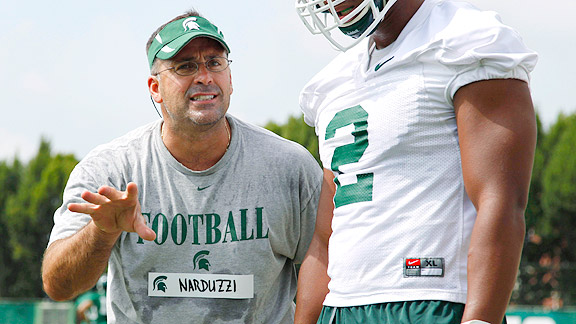
  3. Number two goes vertical.  Here, the reaction is exactly the same as if the number two receiver goes inside.  One coaching point, and it's a major disagreement I have with the way Michigan State teaches their Quarters, versus mine, is that the OLB should NOT reroute the number two receiver if he's going vertical.  I do not want my OLB "muddying" up the read for the my safety.  MSU teaches the OLB to knock this receiver down, I don't want this.  Number one, it's another technique I have to teach my LB, and number two, it messes up the safety's read on this receiver.  I simply have the OLB drop to the flats.  He does not reroute.  This is VERY important because if the OLB reroutes he may be late to his intended drop target and is doing exactly what the offense is wanting him to do (think pick or rub routes here).  
Ok, now that we have the rules in place, let's look at how all this shakes out vs. some of the various concepts many of us see.

Route Combos
The first combo is slant/arrow.  Against this combination, the safety, seeing number two expand gives a "wheel" call.  This alerts the OLB he's got a flat threat and the corner that he's now a zone player.  The corner will shuffle or pedal out for the three step drop, then upon hearing "wheel" knows he needs to bail into his quarter.  As the corner sees the slant, he calls "in" to alert the safety that the curl is now being threatened.  The safety, shuffles laterally to match the number two receiver's release until hearing the "in" call, at which time he drives on the slant.  These are some of the best collisions in all of football.  My safeties love driving on the slant because they are coming from depth and can adjust on the fly, as well as the fact most receivers are unsuspecting of the safety playing this route.  The OLB, cares nothing of the "in" call because he's heard the "wheel" call which overrides anything the corner says.  The OLB is expanding and trying to "top" the arrow route.  The corner, is over the top of all of this protecting against the double move (sluggo).

Slant/Arrow

Sluggo/Arrow

Now let's move on to the slant/wheel combination route.  This is where the coverage takes better shape and you can see the subtle differences between traditional Quarters coverage and my version.

Slant/Wheel

Here we see the safety driving on the slant, due to the "in" call by the corner.  The safety would have also given a "wheel" call which alerted the corner, he's a zone player now, and also alerted the OLB he HAS to run with the number two receiver now.  What the modification in coverage does, is allow for the corner to play a double move by number one (sluggo), and play off and help the OLB with the wheel route.  The OLB's play, helps the corner squeeze the slant to the safety.

A better example of this is shown below, and that is how the coverage adapts to handling the post/wheel combination.  The safety gives the wheel call and gets eyes to number one.  As one climbs vertical the safety will open to him and must expect the post or dig routes.  Once the receiver's hips sink, the safety can now turn into the post.  I tell my safeties to "run the post for the receiver".  In other words, run the same route the receiver is running.  The corner, will hear the "wheel" call and knows now, he is a zone player.  The corner squeezes the post to the safety, but will do so, keeping leverage on the wheel.  The corner can squeeze down inside on the post, because of the play of the OLB.  With the OLB carrying the wheel, it gives the corner time to help pass the post off to the safety as well as get back over the top of the wheel.  Through repetitions, what I was finding was that the corner was able to drop off and read the QB versus this combination and was breaking more on the throw, rather than the route.  This gives the defense, the old "plus one" advantage we are always looking for.

Post/Wheel
The next combination, is the curl/arrow and curl/wheel.  This is one of the toughest to defend because the curl is so enticing for the corner to jump.  From the illustrations you can see that the safety would give the "wheel" call, this alerts the corner he's a zone player, and the OLB that he must now run with the number two receiver man-to-man.  The corner will high shoulder the curl, and is in perfect position to leverage the number two receiver if this route turns in to the wheel route.  The safety, will continue to expand with number two, because he has not gotten a call from the corner.  Again, the OLB's technique is what makes the coverage work.  The OLB by expanding works into the curl window, long enough to buy the safety time to work to the curl.  If the arrow turns into the wheel route, the OLB buys the corner some time to adjust off the curl and take over the wheel route.

Curl/Arrow

Curl/Wheel
As you can see, the coverage is not all that unlike traditional Quarters coverage.  The only difference is that the OLB is not forced into running with the wheel route by the number two receiver alone.  He has help over the top in the form of a pure zone cornerback.  Yes, this coverage is not as aggressive as traditional Quarters coverage, but remember, it's built for lesser athletes.  Sometimes being overly aggressive with lesser talent can lead to trouble.  What this coverage DOES DO, is still gives you a means of pattern matching that allows defenders to cover receivers and not grass, while having some built-in help for the lesser skilled coverage player (the OLB).

What routes are you seeing?  Send me an email to footballislifeblog@yahoo.com and I'll feature it in the new Mailbag posts.  In the next post, I'll focus on some of the problem routes, and the calls and adjustments used to help the defense defend these adaptations.

Duece

Mickey Andrew's Jet Technique


I have had the privilege these past two seasons to coach using this technique and I thought I would share some of the pros and con's of it with my readers.  First off, the technique is nothing miraculous, and many have seen it for years.  I actually have coached with some coaches that have based their entire scheme off of this technique with quite some success.  Some readers on here will recognize the technique being very similar to that of a defense I had researched in the past called the 4-3 Scream and Splatter defense.

Background
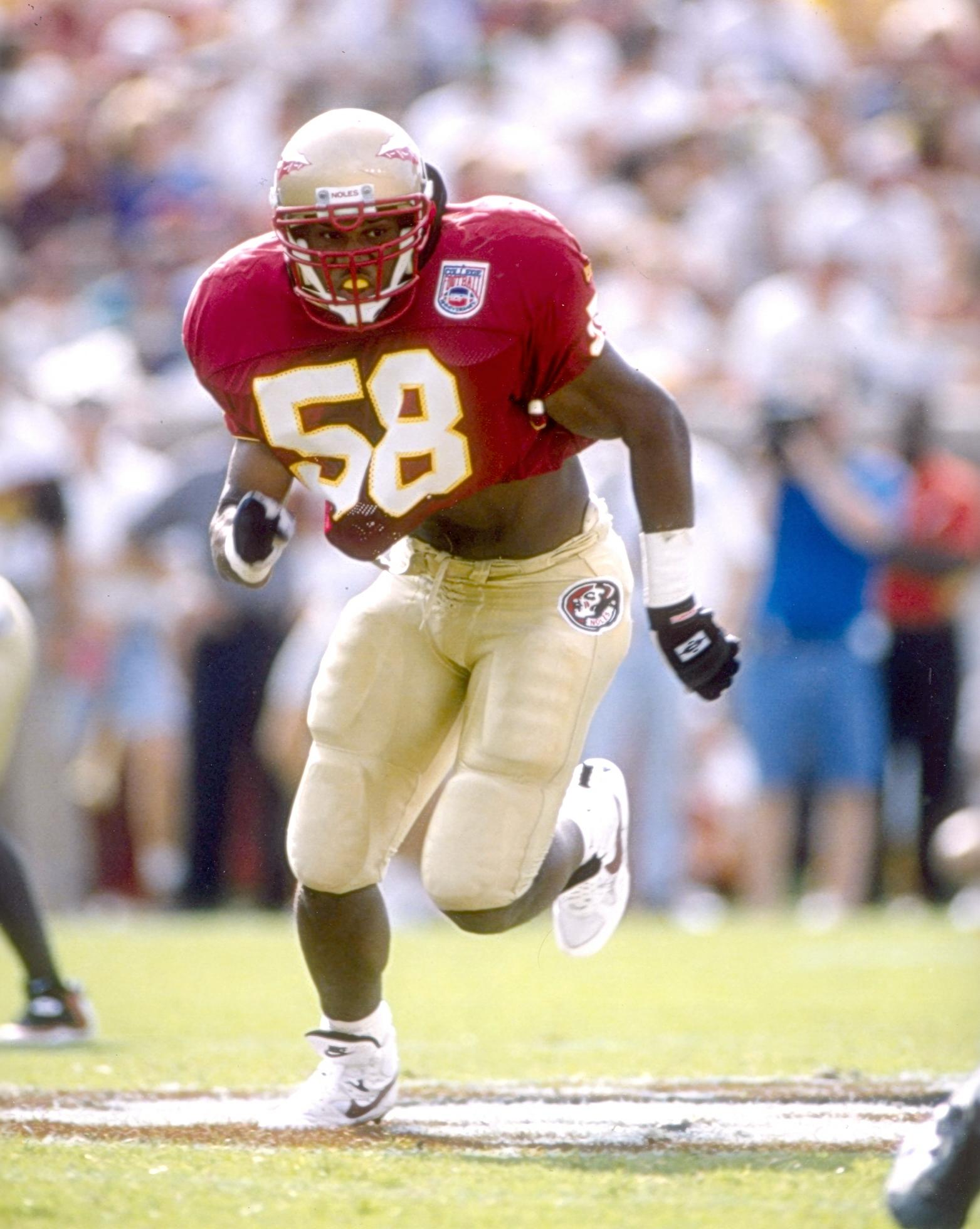
One of the first times I saw this technique was in November of 1996 when FSU beat Florida in Tallahassee, on what would lead to the best revenge game I've ever seen in the national championship game that year.  Florida lost that regular season contest 24-21 and Florida quarterback Danny Weurffel took the worst beating I've ever seen a quarterback take in that game.  Weurffel was sacked 6 times and hurried numerous other times that game by the likes of Peter Bouleware, Reinard Wilson, Andre Wadsworth and countless other Seminole defenders.  I never gave it another thought until in 2005, the team I was coaching was facing an opponent that had it's defensive ends in an odd look.  They were tilted, looking almost in, down the offensive line at a severe angle.  I remember back in the day, the Jimmy Johnson 4-3 guys called this "Smoke", but I'd never seen such a radical tilt by a defensive end.  The other thing I noticed, when watching our opponent on film, was the absolute reckless abandonment the ends had.  They flew in like mad hornets, struck whatever was in their path, ran down plays from behind, and in general, made life miserable for opponents.  The defensive coordinator (DC) I was working for at the time, when asked about this, called it the "jet technique".  He had heard the opposing head coach speak at a clinic a few years earlier on the technique and how it worked.  The more and more I watched it, the more I was absolutely mesmerized by it.  Now, don't get me wrong, our opponent had some cats, they could flat get with it, and their entire defense played with this reckless abandonment.  Anyhow, in the span of 10 seasons, I faced this team at least once every year, only beating them one time.  In seven out of 10 seasons, they utilized the jet technique with great success.  Having had the chance to work with several members of that staff here in the recently, I'm going to elaborate more on how it is taught, it's similarities to regular, block down, step down (BDSD), how not to play the technique and the pros and con's of the technique.  I will also add in how this technique ties into the linebacker play behind it.  A lot of this will not be new, but what will be new is the manner in which the scheme is delivered, by turning loose some of your most aggressive players on some of the offense's weakest players.


The technique
The technique is no different than that of a standard BDSD defensive end.  I had to learn this pretty quickly, as on film, it does not look quite the same.  The reads are basically the same versus the four standard blocks a defensive end will see.

  1. Base block- the DE will attack the near hip and press the blocker back down inside to constrict the running lane and play the spill by the outside linebacker (OLB).
  2. Reach block- the DE will attack the near hip of the blocker and work vertical, to set the edge and force the ball carrier to either cut back, or to "bubble" into the backfield.
  3. Down block- the DE will come flat down the line attacking the first threat to him as he reads down the line to up the field.  This threat could be a pulling guard, kicking out lead blocker, a dive back, or the ball being run away from the DE.  In the case of the ball being run away, the DE is to chase, chase, chase with reckless abandonment in an attempt to get to the football.
  4. Pass block- the DE will attack the near hip, and work vertical to contain the quarterback in the pocket.
Jet vs. base block

Jet vs. reach block

Jet vs. down block


The key component, as with any technique, of jetting, is the footwork of the DE.  The DE must not step up field.   I cannot stress this enough, as if the DE is up the field, he has made the offense's job that much easier blocking him.  The DE must step AT his target.  Even though hand placement, as with standard BDSD, is not critical, the steps, still are.  The DE must step at his target, THEN make his read and adjust his path to the attack point accordingly.  A key item in teaching the DE's feet, is the placement of the down hand when in his stance.  If at all possible, get your DE's to play with their inside hand down.  This will almost naturally force the DE to step into his target.  As with anything that involves technique, the footwork is ever-so critical when teaching jetting.

As you can see, this is all pretty standard stuff.  No real shockers in technique here.  What is the shocker, is what a simple change in alignment, stance and mentality can allow for when it comes to the selection of personnel.

Alignment, Stance and Purpose
The DE assumes a sprinters stance, looking down the line of scrimmage (LOS).  In some cases, the DE is actually parallel with the LOS.  The DE will align one yard outside the EMOL and take this tilted stance.  What this alignment and stance do, is allow the DE to come off like a rocket (we often used to call them "wick lighters" or "bottle rockets"), attacking the blocker at a very high rate of speed.  This makes the defender very difficult to block due to the high rate of speed they can attain.  The more athletic the DE, the wider he can align, thereby making it more difficult for him to be blocked.  The width of alignment also gives the DE the element of time to diagnose the read he is getting.  It also clarifies this read, because of the width of the DE, the blocker has to make a tremendous effort to get to him on the base and reach blocks.  

Jet Stance

The purpose behind all this, is to allow the DE's to play fast and be reckless.  Many coaches having called jet DE's "wrecking balls" or "crash test dummies".  The other purpose behind the technique is that it allows a smaller, quicker athlete to play the defensive end position.  Not everyone is blessed with 6'2" 220 pound DE's in high school.  I have seen DE's as small as 160 pounds play this position with great effectiveness.  The key element with this technique, is the selection of the player to play this position.

Player Selection
The jet DE needs to be some of the names I've mentioned above, such as "wick lighter", "wrecking ball" or "crash test dummy".  They need to be relentless, have zero fear of contact, and understand their role within the defense.  They must be a player that knows, they may not get very many tackles, but that they will get to make contact on just about every play in the game.  The DE must relish contact.  He must not shy away from it, and as many have said, he must be the "bull in the China shop".  Our opponent for the past ten years, has utilized extra wide receivers, tight ends, and even running backs that weren't labeled as "offensive players" to fill this role.  They all shared the above traits in that there was a universal love of contact.  A lesser athlete can pay this technique, but it does need to be modified a bit by tilting the DE more parallel to the LOS and playing him a bit closer to his read, so that he can close the edge a bit better on down block reads.  

Pro's and Con's of the Jet Technique
The pro's of the technique are as follows:
  • It allows for smaller, quicker players to play defensive end in a four man line.  How many times have you heard a coach switch to the 3-3 or the 3-4 because "we just don't have that many defensive linemen (DL).  Jetting, allows the smaller quicker player be effective, so long as they like contact and are not selfish.
  • The smaller, quicker player, coupled with the wide alignment makes the DE very tough to block.  You can almost count on not reach blocking this player with an offensive tackle, and even tight ends (TE's) have trouble with them.  Their head of steam coming off the ball, coupled with their quickness usually stones lead blockers coming from depth, even if said lead blocker outweighs the DE.  You can try optioning off of them, but the quarterback is usually going to pay because of the ferocity at which these DE's come off the football.
  • The reads are very simple, and are a visual key, rather than a feeling key (the way BDSD is).  For years, I've had trouble with the DL getting their hands on a blocker to be able to "feel" the blocking scheme.  The jet technique plays right into what kids use most, their eyes.  The DE doesn't have to feel what the blocker is doing, he gets to see it, then attack it.  By playing into what most high school players already utilize the most, their vision, it allows them to play fast and aggressive, as they trust their reads.
  • It is easy to teach.  You can literally teach the technique and reads in one practice session.  The key is continually repping the fits of the various blocks.  The other key is breaking any selfishness by a DE wanting to "make a play" and not stay within the scheme.  
The con's of the jet technique are:

  • It exposes linebackers (LB's) to down blocks.  This point is argumentative, but I bring it up, because it is the largest flaw I have with the technique.  Since the DE does not get hands on the blocker, the blocker gets a free release to a linebacker.  Now, if it's the OLB, this block is very tough, however if it is the middle linebacker (MLB), then this block is executed quite easily.  The argument here by the proponents are that because the DE "wrecks" shop in the backfield and spills the ball laterally, it allows time for the MLB to get off this down block and pursue the football.  I'm sure this could be debated for hours, but this is my number one gripe with the technique.
  • Lesser athletes struggle playing the position.  In my opinion, you need some pretty athletic DE's to play this spot.  They need to be able to see the read and redirect on the run.  Some kids I've coached, quite simply do not have the natural ability to do this.  If they do not, you can adjust the stance and the alignment some, but not to the point that it is as effective as if the player was a very good athlete.
  • It requires an absolute desire for contact.  In this day and age of the "softening football player", it may be hard to institute this technique because the player must be willing to sacrifice statistics for the love of contact.  Many players we get, simply don't like this, and are very hard to break of their selfishness.  The other thing, is that if they are soft on contact the DE will not be in a great position to constrict running lanes on base blocks, or spill the ball on down blocking gap schemes.  
Jet Technique Coupled with Linebacker Reads

Again, none of this should be Earth shattering, but all of it, is very fundamental in teaching the reads and run fits of the four man front when utilizing the jet technique.  Looking at the reads, from the four reads given above, the LB would react as follows:

  1. Base block- the way I have taught the technique, to keep it simple is if the DE is outside with his read, the LB is inside with his.  If the DE is inside, the LB is outside.  So versus the base block, the DE is attacking the hip and constricting the inside run lane and is outside, so the LB must fit inside this block into the open gap the offense is presenting.  
  2. Reach block- the reach is taught similar to the base, but once the ball has declared itself out of the LB's open gap, he is free to scrape and chase the football outside where the secondary run support should be turning the ball back into both the DE and the OLB.
  3. Down block- on the down block, the DE is inside, so the LB must gap exchange and now be outside.  The LB will scrape and replace the DE, as the DE spills the block, or tackles the dive back.  Again, nothing new from BDSD, other than how the DE attacks the blocker.
  4. Pass block- obviously here, the OLB would read that the OL is pass blocking, and will now get into whatever pass drop the coverage the defense is in would require.
LB reaction vs. base block on DE

LB reaction vs. reach block on the DE

LB reaction vs. down block (note how exposed the MLB is on this play)
Conclusion
In conclusion, I think the technique has merit.  However, I think you have to have the right folks to run it.  You have to have some absolute wrecking balls at the DE position, that love contact and are not selfish players.  As with any technique it must be taught properly as well.  Improper technique will lead to the DE being out of position which, in turn, leads to huge holes created in the defense.  If properly taught, with the right individuals playing the technique, one can have some very good success using Mickey Andrew's jet technique.


Duece

Some More Stunts for the Zone Read

Not that stunt!


In some recent discussions on the Huey board, I decided to dust off a post that was actually supposed to have been posted over a year ago!  It was a thread that was to go along with one of my first posts about the Down and Up stunt against the zone read.  As with many things, I shelved it and haven't been back to it.  Well here it is, and here are a couple of other stunts that may help you against the zone read by giving different looks to the offense.

Setting the Three Technique
This one topic has been debated countless times.  The offense has the upper hand because by setting the three technique away from the running back they have an easy cut back lane if the ball is handed off to the running back.  Not to mention an open B gap to the weak side that they can exploit if they have a running QB by running QB iso to that side.  If you set the three technique to the back, then the blocking on the front side of the zone play becomes a bit easier because of the soft B gap.  So what to do?  The two stunts discussed here involve moving the three technique in a manner that allows the defense to dictate what the offense will do.  If your defense is not flexible enough to move the three technique around, you need seriously reevaluate what you are doing defensively.


Stunt 1- Using the Three Technique as the QB Player
The first stunt is where the 3 technique is set to the RB.  On the snap, the defensive end will slam down hard into the B gap and attack the near hip of the offensive guard.  This will do two things.  To the QB it looks like the end has come down hard and this should be a pull read.  Second, if the ball is given, then the DE will have the B gap for the cutback run.  The Tackle, will loop outside and replace the DE to contain the QB.  Again, if the QB pulls the football, then he will run right into the unblocked three technique.  Obviously the success of this stunt lies in the ability of the three technique to tackle in space.  A good rule is to do this when  the offense puts the RB into the boundary, which gives the QB less room to operate in.


Stunt 2- The Read Blitz
The Read Blitz was introduced to me a few years back as a well to "mess" with the option QB and give the defense another easy way to defend the option.  Against the spread, the defense will set the three technique away from the RB, inviting the cutback.  Pre-snap the weak side LB will walk up to within a yard of the LOS into the open B gap.  This LB is keying the near hip off the offensive guard.  If the hip moves inside, the LB attacks right off this hip and flat down the LOS, looking to prevent the cutback.  If the hip attacks to him, either vertically or laterally, the LB will work to get up field and wall off the play coming to him (could be power, iso or QB zone).  The DE to the side of the read blitz will now become the QB player.  In similar fashion to the down and up stunt, the DE will still squeeze the tackle, but with hands only, being aware not to get his shoulders turned so that he may be in a position to contain the QB if the QB pulls the football (which will more than likely happen due to the DE "squatting").


The beauty of this stunt is that even if the LB gets washed, he's done his job, because he's eliminated the cut back lane in the weak side B gap (which is what most DC's are worried about by setting the three technique to the back).  The major coaching point here is to have the DE squeeze with his hands, and then shuffle down the line, being prepared to tackle the QB.

The read blitz can be used against many types of options and was introduced to me as a way to mess with the triple option QB on inside veer.  Against the veer, the LB simply tackles the dive back if the guard's hip goes down inside.  The DE will still squeeze and sit for the QB.  This is a simple stunt that doesn't take a ton of teaching time to develop and can really foul up an option QB's reads.

A word of caution, be well prepared and know when to run this stunt as it's not the best in the world against isolation runs to the opposite side of the stunt for the lack of the extra player to make up for the extra gap presented by the lead blocker.  It's also a bit tough vs. the pass because now the LB must drop to his zone, being only a yard off the LOS.  This is where detailed film study is really crucial in game planning.


So, that's it!  Just a couple of tidbits to keep you rolling along.  Sorry it's been so long between postings, but life is back to that glorious busy buzz of high school football.  Never thought I'd ever say it feels good to be underpaid and overworked!!!!


Duece