Showing posts with label gameplanning. Show all posts

Defending 3x1 Formations Part V


Part V of the series on defending 3x1 sets is dedicated to pressuring your opponent when they choose to line up in some form of trips formation.  As many coaches have asked me over the years "How do you keep your blitzes sound when they go 3x1?".  It's not rocket science, but you do have to be willing to get a bit out of your comfort zone sometimes.  In this post, I'm going to go over some of my favorite pressures over the years and the how's and whys of running them.  Before that, though, I think the idea of why you pressure and when you pressure is essential.

Blitzing With a Purpose
Most coaches think that blitzing is gambling, or "sending the house", while some coaches think blitzing is what defenses do.  The real idea here (and it's one I've harped on in all four of the previous articles) is attacking your opponent based on scouting data.  Obviously, the less you know, the less you want to pressure until you feel you have a grasp for how it is that your opponent plans on attacking you.  With scouting data though, and tendencies, you can now dial up stunts and blitzes that are geared towards making your opponent play "left handed" so to speak.


Last season, we faced an opponent that would get into trips open, with the running back (RB) set to the trips.  When they did this, they would do 1 of 3 things.  First they'd run speed option into the trips.  Secondly, they would sprint out into trips and run a flood pattern concept (shown below).  Lastly, they would fake the inside zone run, and throw a bubble screen to the number three receiver (again, shown below).


That was pretty much all they did out of this look.  They would even flop the RB over and run one of these three plays.  That my friends, is what you call a tendency.  This was something I felt I could exploit, and we did.  We ran a version of TCU's dog blitz, or the good ol' NCAA blitz, but we made sure to have the flexibility built in to the defense to be able to blitz to the RB.  This allowed us to overwhelm them on the option and sprint out, as well as playing man to man coverage vs. the bubble screen look.


Folks, this is nothing new or revolutionary, it's simply using a tried and true blitz, mixed with good scouting data (I had 6 games on them, 5 of which were vs. 4 man fronts).  This took them out of what they liked to do out of 3x1 gun strong.  They tried to run zone read out of this look, but the stunting tackles makes life miserable for the OL, who now no longer have angles and end up pushing the DL into the path of the RB forcing the cutback to the unblocked blitzing LB.  This was not pressuring for the sake of pressuring, but a well calculated risk that ended up paying off in the long run.

Film study folks...that's all it comes down to.


Solid
Solid was introduced to me a while back, and if you are a base nickel defense, Solid is an awesome adjustment to 3x1 sets.  Solid by itself, is just what many refer to as Palms coverage.  The trips side isolates #1 and #2 and plays them in either a Two read, or Quarters concept, while the weak side of the coverage plays some sort of standard high-low, three-on-two bracket on the back and the single receiver.


I can already here the moans and groans.  "Duece, what about handling #3 vertical?".  I get it, hang in there.  Yes, Palms coverage main weakness when played to trips is the ILB having to handle #3 vertical.  Now, if through scouting data, the team you face doesn't do this, your golden.  Simply play your Quarters variant to trips, and then get a good double on the single receiver with any of the concepts listed above.  Sky is obviously a low-high where the safety robs the curl to flat and will help play inside and under the number one receiver.  Cloud is simply this low-high variant reversed.  In either one, you have a deep half player (sky = corner, cloud = safety) along with a hook player (the LB) to give you a three-on-two advantage that a coverage like Solo does not.  MEG is two man.  This is still similar to Solo, but the main difference is the weak safety (WS) does not have to concern himself with covering #3 vertical to the strong side of the coverage.  MEG, allows you to double any deep route by the single receiver, the back or both with a half-field safety.  MEG is an easy installment if you already run Solo.

The real idea behind Solid is the the last three ways of playing the weak side of the coverage.  Smoke, Cowboy and Backer are all pressures built into the coverage.  They are still man concepts, but instead of being three-on-two, you are now bringing pressure from one of the three players, and essentially playing Cover Zero on the weak side.  Smoke, is the weak safety coming off the edge with the LB handling the back and the corner playing man on the single receiver.


Backer is the LB blitzing the open gap to his side.  It could be the A gap, or the B gap.  You can really set it up however you want, I just chose to always blitz the open gap for simplicity's sake.  Now the safety will roll down and play the RB man to man, while the corner remains manned up on the single receiver.


Solid Cowboy is a corner blitz, and is an excellent pressure when brought from the boundary.  The DE fires inside and the corner comes off the edge.  The WS will now man the X receiver while the LB takes the back.


As you can see, this is quite an easy pressure package to adapt to your trips coverage.  The blitz can be game planned, or simply built in as an auto-check if need be.  The possibilities are endless!

Now, for those that aren't comfortable with playing the vertical of the number three receiver with a LB, there is an answer for this as well, and this is why I stated earlier that if you base out of nickel personnel then you're in good shape.  The coverage call is Special Solid.  Special, or what some others call "Mix", is a man concept on the strong side, or trips side of the defense where the corner will play the number one receiver man to man while the invert and deep safety play a Two Read concept to the number two and number three receivers.  When it's all put together you've got quite a nifty little pressure package that's built in to what most nickel defenses already do.


Now you have a way of controlling the number three receiver vertical, as well as still being able to do whatever variant you want on the weak side.  This flexibility is what is needed in today's defenses, when having to contend with no-huddle, up-tempo offenses.  This coverage/pressure adaptation is easily adaptable to many existing coverage schemes out there.

Attacking the Run
In my opinion, every blitz you run should be sound vs. the run, especially the option.  There are numerous blitzes I could go into, but I think you need to look at a few things first (again, blitzing with a purpose) before just wildly firing off at the hip with a myriad of blitzes.  The types of runs you face, are going to, by-and-large effect the blitzes you need to call.

Defending zone schemes with is usually done a few of ways for me.   I have heard this concept called "Flick", "Hawk", and "Press".  Anyhow, looking at the nuts and bolts of the pressure is simple, because it's not really a blitz, but more a leverage issue created by alignment.  It is a read pressure, meaning that if the LB reads pass, he will still get his drop, but if run is read, he will immediately fill the gap he's aligned in.


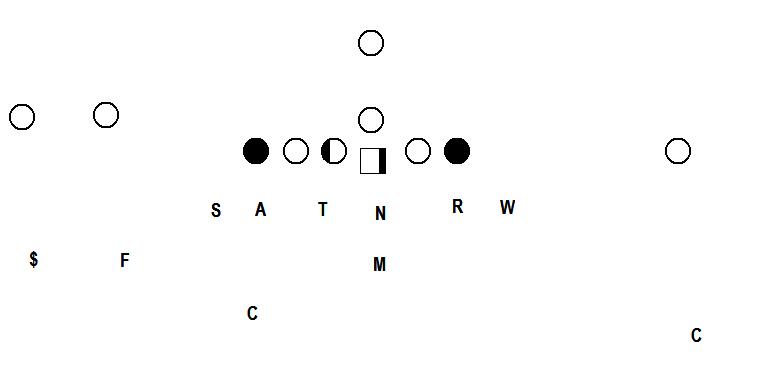
Pre-snap, the WILB, in the above diagram, simple walks to a toe-heel alignment with the DL and sits in the B bap.  He's reading the OG to his side, and if the OG fires off, he will blitz the open B gap.  As you can see, the OG has no leverage and is in a poor situation.  If the OG comes off, this leaves the center attempting to reach a 2I, and unless, he's one of the Pouncey twins, the likelihood of that happening is slim to none.  On the side of the RB, the offense already has leverage issues because the OG has to try to come under the three technique to get the other ILB.  The ILB plays the cutback to the A, or, if playing TGOG, can play over into the B gap while the three technique two-gaps and ends up in the A gap.  The DE plays a 2-for-one read by squeezing down, keeping the shoulders square and playing for the pull by the QB.  The offense is in a no-win situation, as if the QB gives the ball with the DE's read, or if the OC simply calls the zone to the soft B gap bubble, they are in trouble.  Again, this is an easy install and read for the LB.  If the OG were to high-hat, he would drop out and play his pass assignment.

Another way of defending these zone schemes is with pure inside pressure.  TCU's bullets scheme is a good way to handle zone teams.  I like setting the DT's evenly either in 2I's, or threes and then blitzing or stunting and blitzing to confuse the offense.


The idea here is sheer numbers.  The offense cannot account for 6 players blitzing without somehow adding a lead blocker.  It should be noted that an even more effective way to run these blitzes vs. zone teams is to have the LB's align toe-to-heel with the DL.  This keeps the OL from being able to execute their signature double-and-scrape technique.

Lastly, I like to run what TCU terms their "Smoke" blitz against zone teams.  What I prefer to do is set the front to the back, then slant away from the back and bring pressure off the edge.  What this does is invite the offense to run zone to the soft B gap away from the back (some teams actually check to this).  It also dupes the QB into a pull read that has him running right into the teeth of the blitz as well.

Smoke to back away from trips

Smoke to back set to trips
A schematic point on the Smoke blitz is that when blitzing the back set to trips, it may be a little more convenient to have the SS make a "switch" call to the ILB and send the ILB instead.  Again, this is based on preference and what you are attempting to achieve, but usually the strong side is to the field, and having the SS come from so far, all the while having the WS have to come over and cover #3 strong can be a lot of moving parts for some to handle.  The easy adjustment here is to simply switch the call between the SS and the ILB.

Defending gap schemes can be a bit tougher, due to the fact that determining when and where they will hit can be a bit challenging.  One scheme that comes to mind is Power and Power Read.  The new craze with offenses in the option game is the Power Read scheme.  We faced a team a couple of seasons ago that ran this play, but also ran QB Power and QB Isolation back to the RB.  The Smoke blitz from above is another good blitz vs. gap schemes.  What we ended up doing is setting the front away from the back, and then also slanting away from the back.  We also set the front up with a 1 and a 3 instead of the traditional "G" look.  The reasoning here is that when the offense pulls a lineman, they now gain a full man advantage on you to the side the OL is pulling.  If your numbers were matched pre-snap, you are now one full man down on the side the offense is attacking.  The Smoke blitz allowed us to bring pressure to the side the offense ran Iso and Power to, but by slanting to the Power Read side, we made life miserable for them.  When we called this, the strong end would align wider than normal (about like a 9 technique).  This allowed him to still work on plays away from him, but also put him in great position to attack the sweep portion of the Power Read play.


Two key things I liked about this pressure was this:

  1. The ILB's did not blitz.  This allowed them to make their reads, and "clean up" anything the blitz didn't get.
  2. It's only a five man pressure.  Against 3x1 formations, you can run a zone concept to the trips side and a man concept away similar to a zone blitz, or Cover One scenario, not leaving your defense as exposed as if running pure Cover Zero.
Another thing I liked about it, was the three technique slamming into the OT, helped pull the guard over, creating a huge gap for our Nose to run through.  The center, assuming he's blocking back on Power Read, missed this block quite a few times that night.  Our Nose had a field day with this call.  You can even run this look against traditional two back power teams.  The idea is that by crossing the Nose from weak to strong, you match the numbers that the offense presents to the attack side by them pulling a lineman.  

Attacking protections
I know most coaches want to hear how to attack specific protections.  For the most part this works, and yes I've got blitzes in my toolbox that work for Slide, Turn back, and Big-on-Big (BOB) protections.  However, I think the protection is only half of the big picture when pressuring the pass.  I think through diligent film study, you need to find the two weakest members involved in pass protection, and find ways to attack them.  Sometimes this can be a undisciplined OL that tends to chase a stunt, rather than pass it off.  This may be a RB in slide protection.  Whatever it is, identify the two weakest elements of the protection and work from there.

When attacking protections, there's a few ways to do it.  I narrow these down to attacking the flaws in the protection, vs. deception.  Most on here, know how or have at least heard how to attack various protections.  The good ol' NCAA blitz to the RB's side in Slide protection is one that comes to mind here.

America's blitz!

Obviously the idea here is to overload the protection by sending four to a side that only has three blockers.  Teams are wising up though, and utilizing Half Slide schemes and vertical set pass protection etc.  I feel more and more, disguise and deception pressures are of more order than simply breaking down the intricacies of the individual pressures.  

One very deceptive pressure, isn't really a true "pressure" in the sense that most think.  Only four will be rushing, but it's a read rush.  What happens is out of  a six man box, the LB's walk up to the outside of the DE's and are on the LOS.  The DE/LB combo reads the block of the OT.  If the OT blocks down, the LB blitzes and the DE drops.  If the OT kicks out, the LB drops and the DE rushes inside the tackle.  This provides a bit of confusion as to who is blocking who on the OL.


This can be a real good empty pressure too, because a lot of times it gets empty teams to check to some sort of hot route, and with two immediate droppers working into where offenses like to throw hot, you can get a free sack by simply confusing the QB.

Another blitz that has been a good one to me, that also has a deception package built into it is Florida's Nickel Tracer.  I wrote about it a while back, with some help from my good buddy Coach Hoover.  This blitz is a good one, in that you really end up running the "Trick" version of it more than the actual blitz.  

Again, not all pressure has to be sending five, six, or seven rushers.  The mere appearance of pressure is sometimes good enough to confuse offenses into checking into a bad call or bad protection.  I know many of us as DC's want to throw a myriad of blitzes at our OC counterparts, but something that has worked for me for years is a call I simply tag "Bluff".  Most of my blitzes are one word calls, so we simply tag the blitz Bluff.  For instance our Will off the edge blitz is WOE.  If we are planning on running that blitz a bunch, then we will also work on WOE Bluff.  Here the WLB walks up as if to come off the edge but backs out at the last minute and plays base defense.  Pretty easy concept to install, and can easily create as much confusion as if you actually blitzed!

"Check, check, 55 Deuce Tampa, 55 Deuce Tampa!!!"


Conclusion
Pressure packages are what send all DC's into a frenzy.  I'm sure if someone studied it, books on defensive pressure are probably the top sellers.  In my opinion, there's no exception for dedicated film study.  A defense that is prepared, and well-versed in what and how their opponent plans to attack them can look like they are blitzing and attacking even when they are playing base defense.  Don't get caught up in all the zone blitz schemes and blitzes-of-the-week talk that has folks so fired up on the Internet these days.  Work the hell out of your base package, do tons and tons of film study and teaching to your players.  All this being said, it is good to have a few things up your sleeve that may help your kids in certain situations.  Again, when and where to use these, are a product of dedicated film study and game planning.

That concludes the posts on Defending 3x1 sets.  I hope you enjoyed them, now I can get to writing about some other topics!  Take care.


Duece

Some General Thoughts on Defending Spread Tempo Offenses


Well, now that the bowl season is finally over, and I have almost completely overdosed on watching games, I must say I do have some thoughts on what I have seen defensively.  Now mind you, this is purely observational, and not stitch of what I'm talking about or illustrating has been confirmed with film, so basically this post is me bullshitting with you over a couple of beers at the local pub.  Now that we got that out of the way, let's look at my thoughts on what I viewed over the bowl season.


  1. There is no, and will never be any, substitute for fundamentals.  The teams that did the best job on defense not only tackled well, but tackled well in space.  They fought off blocks, reacted well to schemes, made reads and utilized very good footwork and technique.  The biggest skills by far is coverage footwork and transition and tackling.  
    1. Tackling- The spread schemes have an inordinate amount of ways to get players out-leveraged, out-flanked, and just generally in a bad position to defend whatever play is being run at them.  The packaged plays concept, along with multiple formations, reads and options being utilized has made many a great athlete look silly whiffing at air.  Good teams tackle, but great teams tackle with a purpose...EVEN IN JANUARY.  I don't give a damn what time of year it is, you must tackle.  I do tackling drills everyday during the season up until about games five or six, then I taper off, but even if I'm in the playoffs we are tackling once a week and still doing form/fit drills everyday.  The hardest thing to recreate as a defensive coach is open field tackling, but it MUST be done if facing these types of offenses on a regular basis.
    2. Coverage footwork- The good teams have not just had spectacular athletes in the secondary, they've had great technicians in the secondary.  A DB has got to be a master at his craft.  This was no more evident in the BCS National Championship Game where Chris Davis in the beginning of the game used poor footwork on underneath routes to allow a couple of easy first downs.  Later, Davis (yes, I'm being critical of him) made huge error in the way he played the ball, receiver and the route on the pass interference call that led to him making the most critical error of the game (which had nothing to do with fundamentals).  On the goal line, playing in man coverage Davis aligns head up, yes HEAD UP on Kelvin Benjamin and allowed the big 6'5" receiver to body him up on a slant route in the end zone for the game winning touchdown.  Facing spread attacks requires that DB's have meticulous footwork and they must be able to play the ball in the air well.  This was never more evident than vs. one of the best defensive back coaches in the country than Nick Saban himself.  Saban's DB's time and time again found themselves in poor position because of poor technique.  Now, I will agree, there were some mismatches.  As one person put it, some teams just don't match up well against others.  May not mean one is better than the other, but the end result is the same.  The match up issues led to technique breakdown, and well, you see what you got.  The same could be said of Texas A&M's DB's or Baylor's.  
  2. Schematically, I honestly feel man to man coverage HAS to make a major return to college football.  I know "living" in man, is not for the faint of heart, but even the match up zone coverage gurus are going the way of pure man on even their zone pressures.  Three-by-three zone blitzes are going back to the old grass roots man free blitzes of yesteryear, but with better eye control and leverage setup in the general attack of the blitz itself (blitzes must really be option centered now or spread option offenses can seriously gash your defense).  Man free and Cover Two Man have to make a comeback, at least until the time being.  I mean, hell, let's be honest, even Saban's version of Cover 3 (Rip/Liz) is basically man free.  Man to man cuts down on the amount of open grass receivers are allowed to attack, and not going pure cover zero all-out man allows you to have a match up problem with help over the top or trailing help underneath.  
  3. Zone coverage is not dead however, but must be disguised, which leads me to my next point that the defenses intentions MUST be disguised.  From blitzes to stunts, to coverages, EVERYTHING must not appear as it seems.  The QB is not the only cat you have to fool either, the offensive lineman are the keys you must really fool.  I'm really surprised at the lack of amount of stemming you see defenses doing these days.  Stemming is easy and can be added to any call.  Regardless of tempo, most offenses at least take a second to look over the defense pre-snap, this is when you shift, then shift again.  Build in good hard fast rules too for when caught in a shift.  I always tell my guys when caught, keep working to your gap, don't stop and smell the roses and more importantly DON'T PANIC!!!  Disguise is a must because offenses have become so successful at reading a defenses' intentions and then changing the play, gashing the defense, aligning quickly and doing it again.  This disguise can help slow down the up-tempo schemes of today by making the offense have to reset or "re-audible".  
That moment when you realize this was a poor disguise...

    1. More to elaborate on disguise, one thing I liked was how Missouri would show 1 high coverage, then rotate pre-snap to 2 deep, or even, rotate the deep safety down and down safety deep.  I was amazed watching a defender, aligned 5-6 yards off the ball, bailing before the snap to become the MOF defender.  Some of the coverages looked like zone, but some were also man free as well.  I thought the idea very ingenious because you rarely see one high, MOFC coverages morphing to two high, or better yet, rotating much in the way a four-spoke secondary would.  These types of adjustments must be made.  In other words, make the unordianry, ordinary.
  1. Obviously pressure must be a consideration when facing these types of offenses.  I think pressure for pressure's sake is not a good mantra however.  I think you have to the standard stuff of evaluating protection schemes, QB strengths when pressured versus when not pressured, run pressures versus both gap and zone schemes etc.  The no huddle presents some issues with pressures in that they must be simple, so they can be signaled in quickly.  These pressure packages must be dynamic so they can adapt to the myriad of formations, shifts and motions that your players may see.  Making your pressure packages multiple, but simple is key.  A backside twist added to a field dog blitz is an easy adjustment, but must be communicated and taught as such.  I think being able to "tweak" a pressure with such nuances is very important in being able to give an offense multiple pressure looks throughout the course of the game.
  2. Anti-pressure is another schematic theme that I think defensive coordinators, especially at the high school level should embrace.  Several years back I was facing a very good running QB, with some highly talented receivers (one is entering this year's NFL draft).  We had no answer in our base 4-3 package.  I stole an idea from good ol' Gus Malzahn and utilized a three man front where I simply changed out our 3 technique for another linebacker and played my traditional Mike linebacker about 8 yards deep so he could drop down the middle in a Tampa 2 look.  We went into that game with 4 pressures, 3 zone and 1 man.  We were a 24 point underdog and only lost by 11, confusing the hell out of our opponent with this look.  Now we ended up down by 21 at the half, because as the score got further out of hand, I kept bringing more and more pressure, which led to mistakes, and our players feeling like they needed to press.  In the second half, I called a man blitz, our safety slipped covering a dig route and we were down by 28.  After that I simply quit blitzing and dropped eight into coverage.  On the first possession they threw a pick that led to us scoring.  Second possession we forced the first punt of the night.  The less we pressured, the worse their QB played.  What was happening was we were reducing the size and number of windows this young man had to throw through.  What he began to do then was tuck and run when he got nervous about throwing a pick.  So we quit rushing our Nose, and let him and the stacked Tackle spy the QB.  This made things more and more frustrating leading to two more second half turnovers.  My point is this, don't always think you have to put the pressure on the QB by rushing him.  Sometimes it's better to put the pressure in front of him with coverage and a minimal rush.  I've actually done this more than once, and had it work quite well on more than one occasion.  I think DC's don't need to get caught up in drawing up these wide arrays of blitzes that send safeties and drop tackles etc. just for the sake of trying to sack the QB.  If you are having trouble getting to him, my answer would be, then make him have trouble finding anyone who is open.  What bigger waste of a player than having five offensive linemen blocking two or three defensive linemen, while the other eight or nine players are in coverage, confusing the QB?  I know it's contrarian, but think about it, once I made the leap, the dropping eight or nine has been a part of my spread defense package ever since.
3 man front 4-3 personnel Tampa 2 coverage

    1. Also to note, this past season, because we had kids that were so new to doing what I was asking them to do, I kept it quite simple.  If we added a "drop" call to any coverage call, that told the tackle (three technique) to drop on passing plays to the low hole zone.  Allowed us to play coverage with our Mike linebacker a bit different, and also allowed us to play our quarters scheme with an extra underneath zone defender allowing the outside linebackers to get to the flats quicker.  Again, just thoughts on paper, but knowing some body's tried them and had success with them sure helps.  
Drop call given to 3 technique

  1. Brophy had mentioned this before, but developing simple defensive concepts that can be communicated effectively and quickly are going to become more and more the norm in at least college football.  I think high school coaches have a bit of time on their side before we see the tempo of the college game, but it looms in the very near future.  None of this was more evident than when Alabama played Oklahoma.  Oklahoma, who throughout the year had done some tempo, wasn't anywhere near the Oregon's or Texas A&M's in terms of playing speed or number of plays, however with the break, and what Stoops knew about Saban's defense, they obviously worked on it and exploited it.  I may make a bold prediction here, but Saban's days may be numbered due to his inability to adapt.  He's had two years now of dealing with both Texas A&M and Ole Miss, both of which operate at high speeds and he's had trouble with these.  That's because Saban, like all of us, likes to be right.  Many a master craftsman wants his hands in everything, and it takes those of us who pride on using our minds to stop our opponent to a dark place when we have to rely only on fundamentals.  However, that is where the game is headed.  Fundamentals, who at some point in the collegiate game had taken a back seat to scheme, will now prevail (as it should).  If Saban doesn't adapt, as other college coaches, it could get ugly for them and ugly in a hurry (no pun intended).  Saban himself, along with Will Muschamp have already talked about scrapping their time eating offenses for the more glamorous no huddle, speed-in-space, up-tempo offenses.  
    1. Where this takes defenses is they are going to have to educate the signal callers on the field even more so than before.  The signal callers are going to have to work in a way that they are essentially the coordinator on the field and get the defense in the right front and coverage in a very short amount of time.  The problem with this, as with defensive football in general is that it is reactive, where the offense is proactive.  Sure they have to snap the ball, but even if they aren't right all the time, a short throw to a great athlete that's well covered can still turn into six points.  The defense has this to worry about, and then having said short throw (could be a run, just using the short throw as an example), NOT be covered due to a bad pre-snap read, and it also turns into six.  This is where the teaching responsibility lies with the coordinators and their ability to put their scheme inside the head of a 20 year old.  In the case of high school, sometimes that guy may only be 15!  
What I drew on a napkin from Missouri game, no DVR, so may not be 100% accurate, but you get the gist.  

These are just some of my general notes I've basically jotted down in my phone, or on a napkin as bowl season unraveled before our eyes this season.  I think we could easily be five to six years off before defenses really "catch up", and I use that term lightly because defensive football is behind the eight ball already as the game is designed to be entertaining, and a nine to seven ballgame isn't really appealing to the average fan.  I also agree with Brophy on his new standards of measuring what a good defensive outing will be in the near future.  I think the time is gone where you see shutouts, or very low scoring affairs.  For those of us who are "defensive minded" this may be an issue, but it's like anything else, you either adapt, or you die.  


I'm thinking very seriously about working on a collaborative effort to look at this more closely.  I have contacted a couple of other bloggers about this, as I think it was our readers would want, and could greatly use.  If you have any suggestions or comments, shoot me an email or hit me up on Twitter @FootballIsLifeBlog.  Hope everyone had a great holiday, and is ready to hit the off-season in full stride!

Duece

The Passing of A Great One


Haven't had much time to write, but I wanted to share this one for sure.  My former head football coach, Dan Haley has passed away.  Haley, like many other coaches, was more than just a coach.  He was a father figure, mentor, and life-long friend to anyone he ever coached.  I had the pleasure of both playing under and coaching for, Coach Haley in the late 90's.  I learned a lot about, not only the game, but about how to treat players, and that a coach can give his players so much more than X's and O's.  Coach Haley, who has a very impressive record to say the least, was even more impressive when he was doing what he did and loved best, mentoring young folks.

When I first met Coach Haley, I had no clue what to expect.  He was a large man, but very humble looking, and then he spoke.  He had this booming voice, and he enunciated everything with perfection, despite having that traditional Kentucky drawl.  I've had several football coaches through the years, and worked for several others, but Haley was a guy that didn't speak at you, he spoke to you.  He deeply cared for his players, and he made that known, right up front.  He made no bones about the fact that you were his players, and that he was going to do everything within his powers to not only make you a good football player, but help to make you a good person.  I always liked that, and a lot of my coaching nowadays reflects that same dedication that Coach Haley gave me.


Some things Coach Haley taught me as a player were the triple option, to be detailed in your preparation for your opponent, the way defenses defend offenses, and how to properly execute a trap and a log block from the guard position.  There were countless other items he taught within the scheme of the game, but these I remember the most.  He was very no nonsense in his approach to the game, very business like.  There was time for fun, but when he was teaching, it was all business.  I liked this very much about him, as his professionalism was unparalleled by any coach I had before or since.  I liked the way he made me feel like I didn't want to just play for him, myself, or my teammates, but the fact that he taught us to go out and be the best it is at whatever is being asked of us.  It didn't matter if you were a scout team linebacker trying to give the offense a look, you go out and you do that to the best of your God-given ability to help the unit as a whole, and because that is how EVERY man should embrace EVERY task he's faced with.  This has stuck with me through the years, so much so, that I even just used it yesterday when talking with our third string quarterback about his lack of motivation.  Anyhow, Coach Haley taught me an awful lot on the football field.  I remember him taking over an hour to show our quarterbacks how to take the snap from center and to step properly on the inside veer play.  I truly credit my love of triple option football to Coach Haley.  He was an absolute master of it, and knew exactly how it should be run, and knew exactly what needed to be done to adjust it when it wasn't working.


Off of the field, Haley was a man who could talk your ear off about anything.  He loved when players would come by and see him in the off-season.  He'd talk til' you could'nt stand it anymore and then talk some more!  I always was ready when he sat down to tell a story, or just shoot the breeze.  I knew that hidden somewhere in his talks, was a message.  Every time he opened his mouth to talk to young people, there was a purpose to it.  I remember our running back, after getting a big first down run against our rival one year, jumped up and flexed his muscles, almost drawing a flag.  Later, on the next week, after we won (of course) and our coach was reviewing the film of the same run and stopped the tape (yes, it was tape back then) and said "<> was that really necessary?".  Our running back looked down, and then back up at coach and said "No sir, I was just in to the game and happy we got the first down".  Two plays later he fumbled on the 14 yard line, and again, Haley turned to the running back and said "Son, this is why you don't do what you did two plays earlier.  You need to learn to be humble.  Being humble is one of the greatest skills anyone can learn in life".  With that, he proceed on with the film.  I never saw our back draw attention to himself again the rest of the season.  He did fumble a few more times, but he didn't make the focus of the game on him, and again, that really stuck with me over the years.  When a player scored a touchdown, there were no end zone dances, you simply handed the ball back to the official and went to celebrate with your team.  Team was always important to Coach Haley, he was completely about it, and totally committed to making the team his and every body's main focus.  


Haley was also very, very detail oriented.  Me being an OCD cat like I am, took to this with earnest.  He was ALWAYS prepared.  I NEVER once went to a meeting, practice or film session and saw him unprepared.  I came in one time, as a young coach, who's job it was to break down the kickoff and kickoff return teams for our opponents, with nothing in my hands but a blank notepad.  He gave me an off stare at the beginning of the meeting, but that was Haley, he always did things like that.  When the meeting got to my part where I was supposed to get up and show what I'd learned, he stopped me about halfway through me drawing on the grease board and said "How do I know this is what they are going to do?".  I turned and said, "Well coach, I've watched three films and this is what they've lined up in every time".  To which he replied, "I know you know it son, but you haven't given us anything to look at.  All the other coaches have printouts for me to look at, what did you bring?".  I said "Nothing, coach, just my notepad."  He looked at me and told me he noticed it was blank and was wondering how I remembered all the stuff I'd watched on the film yesterday without writing it down.  I told him I had written it down so I could commit it to memory, which he liked, but didn't care for the fact that I didn't bring it with me.  After an awkward five minute exchange he let me continue with my presentation.  I felt humiliated, especially being the youngest coach on the staff.  I took a hell of a lot of ribbing anyways, but this was worse, this was the boss!  After the meeting he asked me to stay for a minute.  I just knew I was fired and hadn't been on the job but three months.  That wasn't Haley though, he saw a moment he could teach a young coach something and he used it.  Even with his busy schedule, he stopped and took 10 to 15 minutes out of his schedule to make me a better coach.  "You need to go into any endeavor you go in to, prepared.  When you come to a meeting next time, I expect handouts and notes.  I don't want any chicken-scratch either, I want nice illustrations and good notes on what information you are presenting."  The next week, I was on, I had handouts and a ton of data on my part of the game plan.  Once the presentation was over, even the old salty defensive coordinator came up to me and said "good job".  Again, Haley stopped me after the meeting and he looked me in the eye and said, "Way to take coaching son, good job", and turned and walked away.  He had that impact on you though.  I've never been unprepared for another meeting for the rest of my career, and I've been called "detailed", "OCD", and a "mad scientist" for my over-the-top attention to detail approach, but I will not change.  If Haley wanted it that way, and he coached me to be that way, then that's the way I'll be!

Yeah, that's me...

The part I really regret about writing this, is the fact that after I left coaching for Coach Haley, I never saw him again.  It's been 15 years since I've seen those glasses looking at me out from under that all-too-familiar skull cap he always wore to keep his bald head warm.  I really regret that.  I called him when I was interviewing for my first head coaching job and got him to send me a letter of recommendation.  With it, he attached a book he'd written, entitled The Difference Between Winning and Losing, of which I plan on sharing with you once the season is over.  He told me to read it, before I took my first job.  However being right up at the time of the deadline to apply for my job, I didn't get to read the book.  I actually didn't read it until after I got fired.  I sure wish I'd have read that book, I wouldn't have even applied for that first head coaching job.  The book is full of Coach Haley, and his perspective on the greatest game ever invented by man.  As I stated earlier, I plan on rereading it this off-season, and sharing with you some things I've taken from it, that will hopefully make you a better coach yourself.

If I could get one more chance to talk to Coach Haley, I'd thank him for helping make me the coach, teacher, and most notably the person I am today.  Coach Haley had a profound impact on my life and he will be missed by countless others.  Again, thank you Coach Haley for everything you did for me, and I promise, to stay humble.  See you over the goal post coach...


Duece

Automatic Coverage Check (ACC)


Playing off of an old article by Brophy about having an Automatic Front Check (AFC), I'm looking more at the automatic coverage check.  I think any defensive coordinator (DC) worth his salt will teach his players a base way to handle various receiving structures that they will face throughout the course of a ball game.  How many times have you gone into a game knowing you were going to see 21 or 20 personnel and the next thing you know the opponent comes out in 10 personnel and starts throwing the ball all over the place?  It's happened enough to me, that I developed an Automatic Coverage Check (ACC) for things we had not practiced on that week.  When I switched to the 4-2 and split field coverage, this idea did not change.  I'm not saying you do this against every opponent, as careful scouting by your opponent will lend you to be out schemed, however by teaching a base method to alignment and assignment vs. various passing sets this will allow your kids a "fail-safe" way of getting into the right coverage for that "odd situation"( as mentioned above). 

The split field secondary makes the ACC just that much less complicated as you are only dealing with half of the offensive formation.  I will talk in TCU terms, as we all know, I'm a TCU buff (if you are interested in some good 4-2 links, go here).  Anyhow, looking at the split field concept, with the ball in the MOF, the read side, or strong side of the secondary can only see the following:

  1. Nub (single TE)
  2. Single (single WR)
  3. Pro (TE and flanker)
  4. Twins (2 receivers)
  5. Trips (3 receivers)
  6. Quads (4 receivers)
To add to that, the away side, or weak side of the coverage will only see the following:

  1. Nub
  2. Single
  3. Pro
  4. Twins


Nub sides


3 backs open-"single" to both sides


Away side reads

So, now that we know what we are going to see to each side, let's see how the free safety (FS) and the weak safety (WS) will set the coverage to their respective sides.

Read Side
To the read side, if the ball is in the MOF, and the FS gets a nub side, then he knows, there are three backs.  In this case, the defense checks into cover 0 Power.  Power is also the front.  The defensive tackles move to 2I's and the DE's move to 5 techniques while the OSS's move into "up" alignments on the LOS and the LB's move their toes to the heels of the DL in their respective B gaps.  The corners take the number one receiver to either side, the OSS's peel blitz the near shoulder of the near back and the FS takes the final number three receiver.  This is my automatic check to any three back offense.  This allows your defense to get plenty of players around the football and still be in sound coverage.  This check also works if the FS sees a single side as well.

If the FS gets a pro side, then he plays "Blue" coverage to that side, however the SS makes a "me" call and this puts the FS inside the number two receiver and we are playing traditional "robber" coverage.  Robber is very simple and to the read side the rules are as follows:

SS- Curl/flat/swing deep of 2.
FS- All of 2 vertical, 2 not vertical rob curl to post of 1.
Corner- Deep 1/2, all of 1 vertical.

Very simple, and we've been over a lot of this before.  The "me" call allows the FS to stay inside the tackle box and fill the alley on outside runs, and play cutback on inside runs.  I speak a lot about the "plus one" player on defense, and this is the player who is not accounted for in the offenses' blocking scheme.  With the FS in the box, yet deep, he is not accounted for in most blocking schemes, so he is free to attack the ball, so long as he does not read pass.  Again, a simple system to put your guys in the right coverage for what they are seeing.

Now, twins is very easy, I tell my guys, no matter the side, we play blue to all twins sets.  Now we will game plan some Bronco coverage in to the away side, and will usually check bronco on the away side when the ball is in the MOF, but to the read side, we are going to play Blue.  There's not much out there that hurts Blue coverage, so this is a very sound check to all twins sets.  Go here to read more about TCU's Blue coverage.


What about twins????

Ok, so now the read side gets three receivers to a side.  Does not matter if it's trips or trey or trio, the FS does not care, all he knows is he has three to his side.  As a base rule, my guys are going to check into Special on the read side.  This puts the corner, man to man on the number one receiver with the SS and FS playing blue to the number two and number three receivers.  Again, this is just a "base" rule, we can game plan for anything, but if we do not expect trips, and we get them, we now have a way for our guys to line up and play, without being confused.


Solo is also another option vs. trips, just not the "base" rule...

The odd "quads" front does pop up every now and then, although, to be honest I see it less and less each year.  Does not matter, you need to prepare you guys for being able to handle this four receiver look.  The idea here though is simple, the read side will play Special to the numbers one, two and three receivers with the WS taking the number four receiver in Solo coverage (away side coverage checks are next). 

There, that's all the read side will see!  As you can see, reducing the field down to only half, allows the defense to set the coverage quicker and get lined up rather than one DB trying to grasp the whole picture of what the offense is doing.  This is one huge benefit to the split field concept.

Away Side
To the away side, things are just as simple.  The WS only has one other job than that of the FS, and that is, he must look at the backfield to determine what he is going to see, and how he is going to set the coverage.  The reason for this is any formation to the sideline (FSL) checks must come through the WS, so he needs to know if the formation is in to the boundary or not, and the backfield will give this away.  Again, for the purpose of this discussion, I'm talking about the ball in the MOF.


Cloud to a nub side

If the WS sees three backs in the backfield, he knows he can see only one of two things, a nub side, or a single side.  Both of these as a base check would be checked into "Sky" coverage, which has the WS as the curl/flat/swing deep of 2 defender and the away side corner as the deep 1/2/all of one vertical player.

To a nub side, the WS checks "flop" and he and the corner will switch assignments.  I do this as a base rule because most of the time my safeties are better tacklers and more aggressive than my corners.  If this is not the case in your defense, then you can leave your corner low and play "Cloud" coverage to that side. 

If the WS gets a pro set to his side, he must play Blue.  This is one area where the read side and away side differ and it's simply because without the SS there is no way that the WS could be inside the number two receiver.  The WS must force, so he has to have outside leverage on the number two receiver.  The automatic check here is to play Blue coverage to any pro set to the away side.

If the WS sees twins to his side, he knows his twins rule states he play Blue coverage.  Again, if the ball is in the MOF and we expect twins to the away side we are probably going to play Bronco, but as a base rule when facing twins, we want the WS to check us into Blue coverage.

Again, these checks can easily be altered with a game plan adjustment.  If a team is coming out in trips and doing something to you that solo would handle better, then simply make that adjustment during a timeout, or at halftime.  Don't let your rules and adjustments handcuff you, build in automatics, and then build your game plan rules to break those automatics.  The automatic checks give your players a fail-safe way to get in the best coverage for the situation that's being presented to them at that particular moment.  This will allow you to still be sound why you and your staff are figuring adjustments on the sideline.


To those that won themselves a district, region, or state championship, I say congratulations!  I'm still searching for that elusive ring, but as they always say, it's not whether you get knocked down, it's what you do when you get back up...


"C'mon kid...get back up and get in that ring!"

Happy Holidays coaches,


Duece

4-3 Lightning Cover 0


A common post on the Huey board about the time season starts is the one about the 4-3 Lightning, Cover 0.  A very popular defensive scheme used to thwart wing-t, double wing and single wing attacks with the good ol' over front.  I'm going to pass along some information that was shared with me by friends over the years with this scheme and then I'm going to tell you what I've come to find out when using this scheme. 

The Lightning is basically a blitz scheme used to attack the wing-t.  It has since been developed to attack other offenses, but the basic premise was the attacking and stopping of the wing-t.  The 4-3 has one major flaw when defending the power run game vs. two or three backs...it has three distinct bubbles that OC's just love to attack.  The three bubbles are obviously the linebacker bubbles.  Now if you have three slobberknockers at LB, willing to bloody their gums every play, you can probably just sit in the Over front and play ball, however most of us has a Jimmie, that ain't no better than your Joe, and before long he becomes exposed.  When this happens, yardage racks up, and against the wing-t it can be a hellaciosly long night.  Moving on now, let's talk about alignments.


Alignments (Pardon the crudeness, these were clinic notes I copied, sorry for any mispellings and all of the shorthand)

SAM = Line up in gap between Wing & TE. On the movement of the ball - shoot inside off hip of TE & then flat down the LOS behind the heels of the O-Line. D Gap responsibility. Wrong shoulder any inside/out block. NOTE: If Wing motions away – contain rush (no wrong shoulder) - QB on waggle.

DE (Wing Side) = 6 technique head up on TE. On the movement of the ball - shoot off hip of OT & then flat down the line behind the heels of the O-Line. C Gap responsibility. Wrong shoulder any inside/out block.

DT (Wing Side) = Conventional 3 technique – outside shoulder of OG. B Gap responsibility. Wrong shoulder traps.

DT (SE Side) = Conventional 1 technique – inside shoulder of OG. A Gap responsibility.

DE (Split End side) = 4 technique head up on OT. On the movement of the ball – shoot off hip of OG & then flat down the line behind the heels of the O-Line. B gap responsibility. Wrong shoulder any inside/out block.

WILL = line up on outside shoulder of TB (on the LOS). Go through outside shoulder of TB. Contain technique (QB on waggle). C Gap responsibility.

Strong Safety = line up on Wing at a depth of 3-4 yds. Squeeze-Contain if Wing blocks Rover. Cover Wing M/M on all passes UNLESS he motions away – then you have the FB M/M.

Mike = Line up 3 yds deep straddling Center’s leg to Wing/TE side. You have strongside A gap on plays to you (stay at home if you lose sight of the ball through mis-direction). If the play goes away – cautious inside/out pursuit. Cover FB M/M on show pass (you may tackle him on his fake on waggle pass).

Corners = line up 7 yds deep on inside shoulder of TE & SE. Cover him M/M. NOTE: Corner on TE side fills vs. run if TE blocks.

Free Safety = Line up 7 yds deep on inside shoulder of TB. Cover him M/M UNLESS he goes to opposite side – then you have the FB M/M. NOTE: Fill vs. run if TB blocks.


Base Alignments vs. 100/900 formation

Now, let's look at these alignments against several common wing formations:

Strong 100/900

Red/Blue


Trips


 Trey


End over unbalanced

Flexbone


Can use motion to slant the 1 and 3 technique, or set them based on field or tendencies.
 
Double Wing
 

As you can see, the front and coverage provide the defense with adequate numbers to defend the offense.  As we all know, alignments are only part of defending an offense, the technique that is applied is the key element in attacking an offense. 

Coaching Points

Sam = The key with the Sam is whether he's spilling or forcing.  This is simple though, if the Sam has a wing to his side, he spills, if there is no wing, he forces, and contain rushes against the pass.  The main coaching point for the Sam is getting off the ball, and getting flat down the LOS.  The Sam should be a very disruptive presence on most strong side runs.
Will = The Will LB has basically the same job as the Sam, except he's ALWAYS a force/contain player.  Again, he has to remember to keep that outside arm free when attacking the offense.  The Will LB is the guy that absolutely destroys the waggle.  In the 7 years I've run this, nobody has effectively run the waggle on my defense (not bragging, just stating the facts).
Mike = The Mike is where I've had some trouble, I've actually had to move mine back from the three yards to five yards.  It depends on the ability of the LB to read and decipher the play.  If you have a kid that has a nose for the football, put him at three yards and let him play.  If you don't, move him back to keep him free of the clutter and allow him more time to read the play, while staying clear of some of the wash.  The Mike should have a field day in this defense no matter where he lines up as he remains relatively unblocked.
DE's = The DE's main concern is slanting and staying flat down the LOS.  The biggest issue I've had with DE's is them getting washed, but this is what the Mike LB is for.  One added coaching point we came up with is that if the DE felt he was being washed, we wanted him to hard post the blocker and rip upfield.  The most important role of the DE is to attempt to pick off pullers.  You will find when run correctly, the DE's can destroy Buck Sweep by executing the slant and getting into the pull path of the pulling guards.  This frees up defenders behind them (such as the Mike LB) to run to the football.
DT's = The one and the three technique execute their normal block down step down technique and play football.  Biggest concern is that your three technique can play the trap.  Other than that, everything else is standard 4-3 DL play for the interior guys.
Safeties = The SS plays closer to the LOS as he is generally the force player to the strong side.  On runs to him, he plays the spill by the Sam and the strong side DE.  The FS will play slightly deeper, but will follow the same rules as the SS.   Biggest coaching points with the safeties is to not lose sight of their key when their original key motions away.  On any motion, the safeties will take the FB man to man.  This all but eliminates one key element of the wing-t passing game...the FB in the flat on waggle.  With a contain defender right in his face immediately and a defender in great leverage to jump the flat route by the FB, the QB finds himself in a miserable predicament when running the waggle play.
Corners = Corners have a pretty simple night, play man on an end.  I have found, in years where I played little to no man, coaching the corners eyes became a major factor to them not getting beat deep.  I have been blessed with decent enough corners that even if there was a misread, we didn't get beat deep.  If you play a lot of man in your scheme already, you won't find that this is an issue.


Dealing with motion

Motion is handled easily in the defense, as assignments simply "bump" from player to player based on motion.  Take a look at the standard Red/Blue formation.  When the wing motions away from the SS, then he takes the FB man to man, as he's the next back inside now that the wing has motioned.  The Sam/Will on the side that motion is coming to will peel blitz to the motion.  This ensures their is a man on the FB on waggle and that the motion man is accounted for on the frontside of motion plays.  This also ensures you don't have players "chasing" motion all over the place against these type "quick motion" offenses.


Lightning vs. Motion
 My Experience With Lightning

Where I have found the Lightning blitz to be the most successful is when used as just that, a blitz.  When I first ran this defense I ran it coupled with my under front and we slid into it and used it as a changeup blitz.  I had a lot of success early on, and so we ran it more and more, until I finally stayed in it.  However, this past season, we faced a mediocre wing-t team and we played the Lightning and gave up 346 yards on the ground and took a 34-7 ass whoopin'.  Biggest problem was DE's being washed as well as the Sam backer and the Mike getting caught up in the wash on misdirection runs.  We got out of it in the second half and basically played a 4-4 look with robber behind, but the flood gates had already been opened. 

Like I said, played as blitz call, it's flat awesome.  I usually called it when I thought we were going to get the following:
  • Buck Sweep- The pinching DL usually got one, if not both, guards and left the RB standing there with one to two unblocked defenders. 

  • Waggle- As I mentioned before, if you're Will is a hitter, he's going to love the Lightning vs. waggle.  The QB comes off the playaction and turns right into an unblocked rusher.  The guard simply cannot get there in time to block him.

  • Keep pass- I saw an AWFUL lot of belly the past three years and the team we faced ran it to the nub TE side.  Again, the Sam comes clean off the outside as does the Will and you are just sending too many for them to block. 

Weakside Belly gave the defense some fits, as did weakside buck sweep if you couldn't get the guards.  A nasty split by #1 to the weakside also made life miserable, because if forced you to do one of two things:
  1. Play the corner in the run game.  The corner now had to read the block of the end, and if he blocked down on the Will, he came up and forced.  Good wing-t teams make the waggle route to this player look JUST like this block.  The team I recently went against did this to perfection.  The end would come down and put his hands on the Will, then sprint upfield and to the corner before we could recover.  This makes life miserable to the weakside for both the corner and the Will.

  2. Move the Will outside the nasty split.  This works good in theory, but you are creating a natural running lane by removing him outside of #1.  This leaves the DE very exposed to being washed and you having a big hole in the C gap area. 


Lightning vs. Nasty Split
 Again, this is why I say use the Lightning as a blitz in certain situations, instead of just sitting in it all game long.  I'm sure some guys who've had success with the defense may chime in that I'm an idiot or something, and that may very well be true, however I've run the defense for seven consecutive years and for the most part the good outweighs the bad.  I just don't think it's the "magic bullet" everyone thinks it is.  One thing us as DC's need to remember is that no amount of scheme will ever replace sound fundamental football. 


Well, to those in the full swing of things, hopefully everything is going great.  Our numbers continue to climb and we are having very productive and fun practices.  We will be hitting here soon, looking forward to our first day in pads.   Good luck as the season progresses!

Duece