Showing posts with label coaching philosophy. Show all posts

Happy New Year!


Hello all, well I know it's been quite some time since the last blog post, and I do apologize, but my new job took on way more responsibility than I originally thought.  With that being said I plan on getting right back to where we were with the Five Spoke Secondary posts.  So stay tuned all as things should get back to normal around here, at least until next fall!


Schematic Musings from 2015

Just some general notes about some things I saw this past season, both where I coach and in college and the NFL.  First off, the number one thing I noticed this past season was a MAJOR resurgence in gap schemes from the spread offenses.  This may have simply been one back power, or inverted veer all the way to buck sweep from the shotgun.  No matter, the number of teams we faced that ran zone schemes, diminished greatly from the previous season's data (2014).  Gap runs are now in vogue in the world of college football, and the trickle down effect is in full swing.

Expect to see more and more of runs like this...

The one thing, at least where I'm at that hasn't really taken off too greatly is that off the Run Pass Option plays or RPO's.  We saw only two teams this past season, in which we played 13 games, that attempted to run RPO's.  Of those two teams, neither did, what I would call "majoring" in RPO's, but more "dabbled" in them.  We saw some packaged screens, and some quick passing off of these looks, but not much other than that, and to be honest, both teams, despite being talented, weren't very good at executing these plays.  I do, however, fully expect the onslaught of these packaged plays to become more and more prevalent the further we travel down football's timeline.

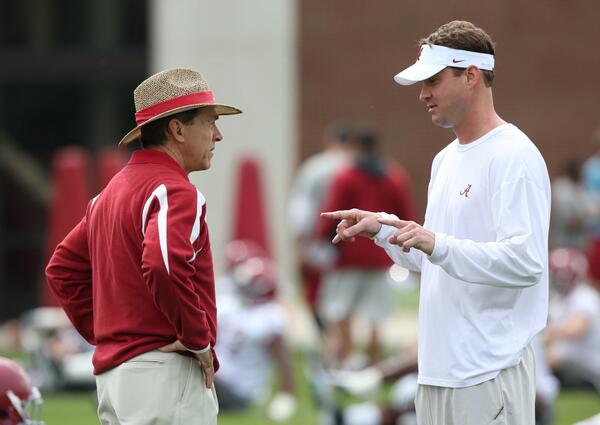
On the collegiate front, It was extremely neat to watch the evolution of Kirby Smart and Nick Saban's defense at Alabama this past season.  Yes, Ole Miss beat them, with the EXACT formula that has been Saban's kryptonite over the past few seasons, however you can see a shift in the thought process at Alabama on several fronts.  The beginning of this swing, was the addition of Lane Kiffin as the offensive coordinator last season .  By adding Kiffin, and bringing in his mind of RPO's and up-tempo offense, it has actually gone so far as to make the defense better.  No longer is an old-school, 3 yards and a cloud of dust, huddle and repeat offense trying to learn up-tempo to give the defense a look.  No, up-tempo is a style of play at Alabama now.  Yes, I know Saban wanted to ban the no-huddle a few years ago, but he's seen the future of college football, and he's done what all the great one's do and that's adapt.  Not to get to schematic with things, here's my list of Saban's adaptations into the "modern era" of college football.


  • The no-huddle up-tempo.  Yes, just what I mentioned above.  His team is now able to mimic these offenses, because up-tempo is in part, what Kiffin likes to do on offense.  Yes, they aren't Auburn, Oregon or Baylor, but they do use tempo as a key part of their offensive identity, which breeds familiarity.  This allows them to give their own defense a good solid look in practice at what they will see during game week.  These looks, being as close to game speed as possible is critical to the defense's success.  
  • I'm sure it wasn't all Kiffin though.  Saban and Smart had to make a dedicated effort to want to change.  In other words, they had to be willing to adapt or mold their philosophy.  One change I saw, was in the secondary.  They both were more willing to drop the larger, run stuffing style of safety Saban has typically employed over the years at that position, for more "cornerback" types there.  Saban and Smart finally realized getting more speed on the field was paramount.  One area that is very difficult to run in sub packages is the secondary.  You need consistency there, and those two found a way to keep the same four guys on the field at all times.
  • They practiced subbing in their various packages against themselves.  Saban hasn't fully washed his hands of personnel groups.  What they have done is figure out a way to use the substitution rule to their advantage.  I read one article where a player said it was "organized chaos" on the sidelines.  What he later went on to say, is that when he first arrived at Alabama...it was just "chaos".  This means there has been improvement in the sideline management of getting the right players on the field at the right time.  The other element, is the size of the sub package.  When watching the National Championship game this past Monday night, I would see no more than three guys at a time run on the field, and usually it was just one player.  This means that they are recruiting players who can stay on the field and help in any situation, something I also think is very key in defending these type of tempo, spread offenses.
  • One key area Saban has upgraded, is special teams.  I cannot, for the life of me, figure out how a guy like Nick Saban got where he is, with such a poor special teams philosophy.  I've never known Saban to have a punter you would consider a "weapon", but I don't know how many times I heard Alabaman punter J.K. Scott mentioned as just that...a weapon.  The same can be said of Alabama's kicker.  Despite missing a field goal in the game this past Monday night, Alabama's kicker has been on point for most of the season.  The other thing is, he kicked a perfectly executed pooch-style onside kick.  I'm not sure in years past if I've ever seen a better special teams unit under Nick Saban.  Special teams, in my opinion, is an area that against the modern spread, up-tempo offenses, where you can gain the advantage by stealing a possession.  Fake punts, onside kicks, and fake field goals are things that have to be done in practice, to a high degree of repetition in order to insure success.  I think this mental shift was none more evident than in the National Championship game by Clemson keeping Alabama's punt block unit at bay with the threat of the fake, and Alabama's critical onside kick.  One was simply just the "threat" of a stolen possession, and the other WAS a stolen possession.  See these offenses are going to score points.  If the idea is to score more, then you need to find a way, at the end of the game, to have had more scoring opportunities than your opponent.  Stealing possessions on special teams is a great way to do this, but most coaches don't put in the time to do so.  This is where I think many coaches are going to have to make their philosophical changes to their approach to the game.


Some other things I've seen, or been thinking about when it comes to defense in the modern age of football is that of the evolution of defenses.  So many teams out there play so many fronts now, it's hard to really say what they truly are anymore.  When watching the National Championship game, one could argue Alabama stayed largely in a 4-2-5 alignment.  I've watched plenty of TCU cutups from the past two seasons, and it looks like they are running a 3-4 scheme at times.  What I think is increasingly becoming en-vogue is splitting the field and covering each half differently.  Whether it be with two types of zone concepts, or whether it be with man-to-man on one side and zone on the other, teams are rarely staying in "pure" coverages anymore.  Setting the coverage to work with the front is also becoming increasingly popular, as we all know in some cases when in man, the secondary cannot effectively provide run support, so now it must fall on the front to do so.  I've seen teams that were typically even front teams with secondary run support, morph into more of an odd front to the man side of their coverage and allowing the front (an end or a linebacker usually) to be the dedicated force player.  Concepts such as this are what is going to get the defenses back into the fold when it comes to modern day football.  

What I think is becoming increasingly an issue is exactly what we saw in the playoffs this season.  In our regular season, we faced eight spread offenses and two pro style offenses in our 10 game regular season.  That means we were pretty geared up to stop the spread.  In the first three rounds of the playoffs, we were facing either Pro style or Wing-T.  It took our kids a bit to remember how to "fit" back into the box, and luckily for us we have some great coaches that were able to get this done, but you could see at times it caused some issues.  We don't sub, so keeping the same 11 out there against the various offenses can get to be a challenge.  The issue is, what to do when you see that one Flexbone, or Wing-T, or Pro I team on your schedule.  I think mixing in periods of practice against these styles of offense throughout the season would be a big help.  Using the bye weeks and spring/summer practices to defend against the option is something I've done since as early as 2005.  It's a great way to keep your fits honed vs. offenses you might not see all the time.  


Anyhow, that's my ramblings for 2015.  It was a great year for me changing jobs and getting to work with a great staff.  I look forward to the upcoming season and the rebuilding job we have in front of us.  For now though, I'll get back to blogging!

Duece

Mailbag Volume 2


I really have to apologize to the coach that sent me as it's almost been two months since I got the idea for a blog post.  I've been so busy with spring football and making the transition into my new job, I totally forgot.  So to the coach that sent this in, I apologize, hopefully this isn't too late.  Anyhow, I had a coach that is in his first gig and was asking for just some basic advice for a new coach getting into the game.  I figured his question alone would be good for a blog post, so it's the only question I'll focus on for this mailbag post.  Let's take a look at what advice I'd have for the guys just getting started.

Like Your Job, Love Yourself
I start here, because many coaches get into the profession seeking success and recognition to fill a void in their self awareness.  I hate to be blunt here, but if you're trying to fill some void and you think winning coaching a sport is going to help, you have big problems.  Sure, winning is fun, and the job can be fun, but you need to be true to yourself first and foremost.  I think you've got to have a good handle on what you think of yourself and what you want to accomplish.  I'm not talking about coaching either, I'm talking about what YOU want to accomplish as a PERSON.  When I first started, all I wanted to do was prove people wrong.  I'm still driven by this, but it doesn't consume me as much as it used to.  See, I was a small offensive lineman in Nowhere, USA that was always told "Too short", "Too fat", "Too slow", "Too weak" etc.  That crap burned me up as a player, because I gave absolutely everything I had when I played.  I had an old baseball coach nickname me "Charlie Hustle", mainly because I worked my ass off for what little playing time I got.  Football was no different for me, especially once I got to high school.  This drive to prove folks wrong drove me to get a college scholarship to play for a small NAIA program.  Now, in the early 90's the recruiting game wasn't what it is today, so exposure was rare (if any where I was from), so to get recruited and get a scholarship was big news.  Still, I had people telling me "You'll never stay", "You'll be back", "You won't make it".  Well, it kept me fired up all through college, and despite having to leave the game early due to injury, I finished school and earned a degree.  All of this led me back full circle to coaching, and even then I was told the words "can't", "won't", "shouldn't".  All of this consumed me to win, and prove others I could do it.  It's one thing to have this negativity consume you as a player, because you can use it as fuel for motivation.  However, if using as a coach, you're now bringing the lives of your players into your motivation.  I was actually using my player to achieve my goals.  This is bad...very bad.  I lost a lot of players in my first few years as a coach, and I couldn't figure it out.  A conversation with an old college coach opened my eyes to the fact that I was coaching for all the wrong reasons.  My last season as a youth coach was one of the best, because I put my goals second to the goals of my players and I opened up and began to love and care for my players.  This epiphany opened my eyes to the wondrous world of coaching to make a difference.  As I evolved, I've learned this, you must at least care for your players, no matter how much of a turd you think a player may be, you can and will make an impact on this person's life.  You cannot do this, if you don't first love yourself.  You must feel comfortable in your own skin in order to help make a difference in anothers life.  I wasn't happy with people doubting me, and it was making me miserable.  In turn, I was making my players miserable.  Once I realized the doubters are always there, and the only person whose opinion of me mattered was the guy staring back at me in the mirror, I became a much better coach.  I still have to revert back and remind myself sometimes of this very thing, because in the back of my mind is that little voice telling me about what the doubters are saying.  Once I squash that voice, I'm better for it, and since learning to trust and believe in myself, I've been a much better coach.  Learn to love you, and then you can truly love others and make a difference in their lives.


Care For Your Players
Like I said above, when I first started, the players were simply a necessary evil in me achieving my goals.  This will not take you far, and you're coaching career will be a hollow shell.  All players, if they are playing for you, deserve to have you care about them.  You, as a coach, cannot impact these players if you're not at least remotely involved in their well-being.  In some cases, the coach is the closest thing to a true parent that many of these kids may ever have.  Many coaches get squeamish when you begin speaking about "caring" (yeah man, that's Dear Abby crap coach?!), but caring is a crucial component to being a good coach.  Listen, I was a part of a team that won a total of two games in a three year period, but I still have players on those teams, that when I see them they hug my neck and actually say things like "Man I miss those days", "Coach, we sure had fun".  What???  How the heck can you go 2-28 and use those words?!  It is because despite the situation they were in, the players knew they were cared for, and they knew the men that were leading them were attempting not to win a football game, but to change their life.  This is why you must have an interest in your players well-being, from there you will begin to build trust, which will allow you to build not only the player, but the individual.

Coach the Individual, not the Player
If I look back on my career, I've taught as much about life as I have X's and O's when it comes to being a football coach.  I've had players get arrested for selling drugs, doing drugs, I've had them get girls pregnant, get into an accident and become paralyzed and even worse.  In the course of all of this, I'm hoping that I've been able to help these young men.  Now I know what you're saying, "Coach this is supposed to be a technical blog, why are we talking about this?". Well, I'll tell you, why.  If you can't coach the individual, you'll never coach the player.  Young adults are very hard to earn their trust these days, and if you can't earn that trust, then you'll never get these individuals to be the player they need to be.  This idea of coaching the individual, the person, instead of just the football player will create trust.  One thing I've always done is ask my players questions like "How are you doing?", "How was your day?", "Is everything ok?".  The other thing, always shake their hand.  A coaching mentor of mine started this a few years back and it has had such a tremendous impact on the people we've both coached.  It's the single smallest gesture that says to the player "I care about you".  Still, to this day, I have players that will come up to me and shake my hand.  I had a defensive back this past season, I had to bench because of a poor attitude, that ultimately led to him being removed from the team, that came up to me at a function later in the year and still shook my hand.  Again, he and I may have had a difference of opinion, but he respected me, and I respect him.  Try the handshake thing.  You'll be surprised.  Kids are just wanting any recognition they can get, and sometimes the littlest gestures, such as a handshake, pat on the back, or a simple "How are you?" will go a long way.  Sometimes, you even have to do it to players you don't like.  You'll be surprised, maybe the player with the bad attitude will soften a bit, and start coming around to your way of thinking.

The biggest part of my coaching philosophy deals with not what offense or defense we are running, compared to the how are we making these kids better people?.  In my coaching manual, that I have prepared for any coaching job that I interview for, this statement is right in the front, under my mission statement.  I'm not here to coach these players to win a football game, or to learn how to kick slide, I'm here to coach them to be productive citizens, good husbands, and fathers.  When I learned this, I instantly became a better coach, because players see this.  Young adults are VERY GOOD at finding out who's real, and who isn't.  If you're fake, they'll find it out and find it out quick.  You have to refocus and direct your attention to making better people before you can EVER make them better players.


Never Stop Learning
Learning, whether it be coaching techniques, or actual technical aspects of the game, should never stop throughout a coach's career.  This is why you pay all those bucks for the clinics, the books, DVD's and pod casts.  The whole idea is to learn and keep learning.  I think the big thing here is don't stop at the standard methods of learning (what I mentioned before DVD's, books etc.).  Dig deeper, visit coaches you respect, visit schools who run schemes you are interested in or maybe run the same thing you do.  Listen, I had trouble defending the wing-t, many moons ago, so I went and visited two high schools that ran that offense.  All it cost me was gas money and some money to pay for their lunches and I had more information on the wing-t than I could shake a stick at.  It was worth it, the following season we held a very good wing-t team to their lowest offensive output of the season.  These things can and will pay off.  Many coaches tell me "Oh, I wouldn't ever ask Coach So-and-So if I could visit his place.".  Why?  You'd be surprised how many would be flattered that you asked.  My new job is at a place where I had a coach ask me this very thing.  He had seen a scheme we ran against another team and liked it, so he called me.  When I say called, he cold called me.  I didn't know this guy from Adam's house cat and he calls me.  We hit it off, have been friends for several years now and he's gone and gotten me a job at a very prestigious program here in the area.  Again, this all led back to learning.  He was trying to learn what we were doing, and in turn I've learned a bunch about what they are doing (TGOG for one thing).

Nothing wrong with traditional methods of learning, but don't be afraid to think outside the box.  One learning tool that seems to have declined here in recent years is the message boards, such as Coach Huey.  I cannot tell you the amount of stuff I've learned from the interaction on that site.  I've also met several great coaches through the Internet as well.  One problem I had, early on, was I thought my crap didn't stink, and my way was the BEST.  This is all a part of the big ego's many of us coaches have.  Once I got humbled a time or two I was ready to listen to some of the guys on the Huey board (such as OJW, and jgordon).  Those guys have passed on some invaluable lessons, that I'm not sure you could get out of a book.

Network, Network, Network
Networking sort of ties into continuing education.  If you visit coaches, or interact on the Internet, this leads to networking.  Rubbing elbows with coaches is a great way to learn, but it's also a way to keep doors open for you.  In my case, like I stated above, it's led me to a new job.  Networking has also led me to some very interesting people, and some very good people.  The yearly clinic we have with OJW has been a great experience.  Some of those guys have helped me make some crucial coaching decisions that either my staff, or the people around me couldn't help me make.  Many of us collaborated on the flexbone posts on Coach Hoover's board, which led us to meeting each other.  These guys are great, they know a TON, and are willing to share.  All of this keeps doors open for your future.  I have no doubts that if one of them called me for a job, or for a reference, I wouldn't hesitate to help them.  I'm also sure they'd do the same for me.  Networking is what makes a people profession like coaching go around.  Don't be in a shell, get out to clinics and talk to folks, meet coaches, ask them questions, share stories etc.  All of it has the potential to benefit you, or the the person you're talking to.
Networking...WORKS!


Run What You Know
I hear this all the time, and I do feel it's VERY important.  Now, only knowing one or two offenses or defenses is probably not going to help you very much, especially at the high school level.  Not being able to recruit leaves the high school coach needing to have a bit of repertoire when it comes to scheme knowledge.  Now that doesn't mean when somebody asks you what offense you run you tell them the "Split back veer, power shotgun, five wide offense" (lol, OC's, got to love em').  What it means is, as the varying degrees of talent enter and exit your program, you as the coach have not only the ability to fit schemes to ability, but have a way to tie the schemes together so that it's not like a scene from the movie Fifty First Dates where you're learning something new every fall.

Knowing your stuff, allows you to fix it when it's not working.  Listen, game plans on paper always work.  However, in-game, is a different story.  Being able to adjust your scheme because you know it inside and out, is essential to helping your players have success.  Many of us watch a coaching DVD on the 4-2-5, or read a blog post, and think "Man I want to run that!".  In reality, a blog post or a DVD doesn't do a scheme any justice.  To be honest, I don't care if you buy Pat Narduzzi's entire DVD collection on his 4-3 defense, if it is your first time involved with the defense, you will not KNOW it.  You need to coach in it, see it succeed, see it fail to really know it.  You need to talk to coaches that have run the scheme you're looking at for quite some time, and had both failure and success with it.  When I switched to the 4-2-5, I jumped early, and really didn't know it.  Luckily for me, through networking, I was able to work through my problems with the help of my friend and made things work.  This caught me off guard, because I honestly thought I knew the scheme, but when it comes to the actual running of the scheme and fitting the pieces together and getting it all coached up, I was a rookie.  Since then, I've been very cautious with what I learn and how I implement it.  I've learned to study the scheme and then try to break it.  I've gone and discussed with other coaches how they'd attack that certain scheme.  I've asked what weaknesses they thought were inherent to the scheme (all offensive and defensive schemes have strengths and weaknesses).  If I feel comfortable with these weaknesses, and have an adjustment, then I'll go with it, but if I can't account for this weakness, I won't install it.


Another thing about knowing your schemes is knowing what it takes, personnel-wise, to run it.  In high school, it is very difficult to have a scheme that is tied to certain body types, and/or athletic ability.  I've always looked at the schemes that didn't take the great athletes to run, or were built for lesser talent and then worked from there.  I always felt it was easier to upgrade a scheme, or add something into a scheme for when the cupboard was full, versus trying to pare down the scheme when the cupboard was empty.

Better have a scheme for these guys...

Also, don't be afraid to adapt.  I'll give you an example.  With the spread coming about, I had to find a way to get my best pass covering OLB to the pass strength.  I tried to make this work, but good OC's would find a way to put this guy into the boundary or away from their best receiver etc. and then exploit it.  I actually had a good coach figure this out, and BEAT me with it.  After that I poured through books, DVD's etc. and found NOTHING.  What I did do, was visit a local small college that ran a 4-3 and learned a neat little adjustment they ran vs. 1 back offenses.  When they faced a 1 back offense the OLB's aligned with the safeties instead of with the front.  This allowed the better pass covering OLB to go to the pass strength and the weaker OLB to be away from the pass strength.  It was eerily similar to what Gary Patterson does with his strong safety in the 4-2-5.  This one little adaptation has paid huge dividends here recently, allowed me to stick to my 4-3 roots, but be as adaptable as the 4-2 everybody's so crazy about.  Learn to be flexible and learn to be adaptable and your schemes will really take shape.

Know Your Job
Whether you're hired to coordinate or hire to assist, know your assignment and your role within the team structure.  If you're an assistant in charge with coaching linebackers, know how the DC wants it coached and COACH IT EXACTLY THAT WAY.  I can't tell you the amount of times I've told a guy how I want things done, only to look over in practice to see them doing something totally different.  Then get the worst answer in all of coaching, "That's the way we did it at...".  Nothing burns me up more.  I don't really care how you did it at your last stop, do it the way I'm telling you to do it.  Now, I don't mind suggestions, but after I've told you how I want it done, you do it that way.  Nothing looks worse to a player than getting coached one way, only to come to group or team drills and have the coordinator talking and teaching to a kid completely different.  Everybody has got to be on the same page.  Whether you agree with it or not, you coach the way you've been instructed to by your superior.

If you're the superior, demand the assistants coach it the way YOU want it.  If you let this slide, there will be issues, I can guarantee that.  Be clear in your teaching of your assistants.  Make sure you know they understand their assignment.  If they have a suggestion, by all means, listen to it, consider it even.  You may end up finding out there's a better way to to do things.  I always like listening to guys that join my staff from elsewhere to see how others do it.  Nothing wrong with that at all.  I had a guy tell me once it made me weak as a coordinator taking suggestions from assistants.  I told him, not at all, it actually makes me a better coach.  First, it gives a bit of ownership to the assistant, which at the end of the day is what they want.  Most guys want to contribute and know that their knowledge is being utilized to achieve the team goal of winning.  Second, you never know when a different way of presenting the information to a high school player may help the player better understand their assignment.  I always give this example, and it is so simple of a change, that it becomes comical, but this one little change made all the difference in the world.  I've told it before, but many years ago, when I was first coaching and we were teaching block down, step down (BDSD), our defensive line coach was using the term "wrong arm".  We were implementing the 4-3 for the first time at a place that was used to running the old 50 defense, so it was something new they were having to get used to.  Anyhow, long story short, I'm at the water cooler during a water break and hear a kid say "Coach Jimmy doesn't know what the hell he's talking about.  Why is he telling us how to do it wrong?".  So I asked the kid, what he meant by that, and he told me our defensive line coach was telling them to wrong arm things.  The kids were confused.  Look, I know it is semantics, but from that day forward, we've never called it wrong arming.  We changed the term to "splattering", and the kids seem to understand.  It is quite comical how one little change in the way information is presented can make the light bulb go off in a kids mind.


Another part of knowing your stuff, is knowing when you don't know.  I wrote about this over on The 12th Man Blog, because I've been a part of a staff that had some guys that if they didn't know, they simply made up what they thought it should be.  Nothing could be worse.  We were recently teaching what the TE does on midline, and the offensive line coach was actually teaching it backwards.  The players actually knew their assignment from using and reviewing their Hudl playbooks.  They were calling the line coach out on it, and it got ugly at one point with the line coach telling the players, basically, they didn't know their ass from a hole in the ground.  I was privy to all of this, and had the chance to discuss this with the head coach and we got it corrected, but the damage was done.  See, with kids, sometimes you only get one chance, so you better get it right.  The better thing for the assistant to have done would've been to simply state that he didn't know what the TE did on midline, but that he'd find out.  The EVEN BETTER thing the assistant could have done, is to know the damn playbook backwards and forwards!  If you're charged with coaching a position, you HAVE to KNOW it better than the players.  However, I get it, we all forget, or sometimes are coaching in a scheme that we may not be familiar with.  Don't be afraid to EVER tell a kid you don't know it.  Then follow that up with, but I'll find out for you.  Again, that goes back to creating trust.  The kid may be disappointed that his coach doesn't know, but he'll trust that you're going to make it right.  Kids will have a lot more respect for you if you tell them you don't know, than if you make something up.  They can tell when you're not being truthful with them.

Help Where Needed
I can't tell you the number of places I've worked where when the last period of practice was over, the coaches beat the players off the practice field.  Here recently, 15 minutes after practice was over, I'd look around and it would be just me and the head coach left on campus with 50 kids under our charge.  Guys would only coach during practice and then when practice was over, they were gone.  Let me tell you, nothing looks worse to a head coach than a guy that just coaches.  Listen, I get it, nobody likes putting away the water coolers, or opening up the locker room, or putting up the sled dummies, but it's got to be done.  There were many times when I was a head coach, if I didn't do that stuff, it wouldn't have gotten done.  This isn't good.  When you're an assistant, you're needed in many more areas than just the practice and game fields.  Help the head coach with anything and everything you can.  If he needs someone to run to the store to get tape, do it.  I find it comical that we had a coach, talking to some of our incoming freshmen about when they get to high school they need to volunteer for everything when at practice.  He'd say, "If coach calls out for a kickoff team, jump up and get out there, get noticed".  I agree with this mentality 100 percent, however, when it came to this coach doing extra work around the school, he was nowhere to be found.  The same holds true for coaching, if the head guy or a coordinator needs help with something, jump up and help them.  It will get YOU noticed, and generally, the boss man will be appreciative for your extra efforts.

Have Respect for Your Job and for Your Organization
I can't tell you the number of young coaches I've had to tell this to.  Basically, if you working for the program, you're doing it all year round.  Don't embarrass the program.  I've had to hire guys fresh out of college, and in some cases, younger to help coach, and you've got to instill this from day one.  As an assistant, you've got to realize that accepting a position with a high school program, puts you under the microscope, right along with the coordinators and the head coach.  There are many places where certain social activities are frowned upon.  If you, as a person, like to do these activities, you may have to curtail how you do them in public.  Drinking is probably the number one issue I've seen with parents and the community when it comes to coaches.  I mean, who doesn't like to blow the frost off a cold one right?  Especially after a long hot practice in August.  Well, if you've coached in small town America, like I have, this may be an issue if you choose to do this in public.  If there are places you can go, and not be so visible to the community, it is probably a good idea if you go there to peel the top of some "bluegills".  I know I know, the big city coaches are reading this and going "What the hell?".  Listen, this issue isn't as prevalent as it is in small town America, but there's other things to consider too.  Social media, and the negativity it can create is a HUGE issue among coaching staffs and their players in today's world.  The idea here, is remember that you're a part of something bigger than just yourself.  Extremely young coaches seem to have an issue with this as they are still in "party" mode, but this is the sacrifice you make when you take the job.  One rule I always taught both my players and coaches was "Never bring a negative light on the program".  Keeping that rule simple, makes people think, and gives me the boss the leeway to remove a player or coach from the program for doing something that isn't condoned.  Just as a general rule, remember you're doing more than just representing yourself when you take on the job of being a coach.

Do it my way, or hit the highway!


Marry a Football Wife
Probably the single most important item on this list.  I can't tell you how many coaches I've lost to the fact they married a woman that simply did not understand the man's love of the game of football.  I have been SUPER fortunate.  I can, without a doubt, say my wife is a football wife.  She's coached for my youth team, and has always been my Filmer from day one.  She is very supportive of what I want to do with coaching and football.  If you can't find this person, then you need to be up front with her about the time involved in being a football coach.  The good ones, don't mind, and even actually like seeing their husbands involved in the changing of young men's lives.  Others, well, they can't handle any competition to their husband's affection, so they tend to get jealous, which usually leads to one of two things and both of them are bad.


Don't forget child rearing either.  Many women are fine with the husband coaching in the beginning, however once the little ones show up, it's time for "daddy" to give up his hobby and grow up.  The good ones realize you'll be there for the family when football gets over with.  I have a friend that is raising five boys, yes FIVE BOYS and is the DC at a very prominent high school.  His wife is an ultimate trooper.  She understands the time involved, because in the beginning this was communicated to her.  I did the same with my wife.  My wife understands my love for the game, and ultimately she has grown to love the game as well.  Anyhow, be up front with the woman in your life.  As they say, behind every good man is a great woman.  Whoever said that must have been talking about a coach's wife.

Know Who You're Working For
I think this is one that's probably burned me more in my coaching career than anything else.  I'm a very open and trustworthy person, so I have a tendency to get close to people without ever first diagnosing what they're about.  Lately, I've gotten better at this, but I'm still vulnerable when it comes to assessing just what somebodys motivational factors are.  I think many young coaches, when they go through the interview process, are just so thankful somebody called them about their application, they forget that this job is what is going to help define and shape their careers.  I was exactly like this when I interviewed for my first head coaching position.  I failed to ask all the right questions that a coaching candidate needs to ask.  There are certain items you will need in order to be successful, DO NOT take any of these for granted, just because YOU think they're important.

There are numerous sites you can go to about interviewing for coaching jobs.  One of the best I've seen is Coach Fore's website and consulting service.  He does a good job breaking down interview questions, as well as coaching the coach on what questions they should be asking during the interview process.  Remember, it's a lot like buying a car.  The people interviewing you, in my experience, rarely want to be there.  They look at having to look for a football coach as a necessary evil of their job, and many just want to get it over with.  I find that these types, generally aren't worth working for.  The ones that ask you what you think they need to build a successful program, or maintain a successful program are the ones that pique my interest.  Folks that are goal-oriented, and are always striving to get better are the ones I like to be around.  The reason is, these people are generally constant thinkers (much like myself).  Nothing is ever good enough, but not to the point that they demean the current system or way things are being done.  These people are just generally always trying to build a better mousetrap.

Hmm...


You really need to know where your boss is coming from and what their perception of the football program needs to be.  Many will give the generic answer of "successful", "winning tradition" etc.  Few ever delve into what they really are thinking.   You need to know how this potential superior will handle situations in which he or she should have your back.  How are these folks going to handle an altercation with a player or parent?  What about an altercation with a coach that may need to be reprimanded or, even worse, removed?  These answers are tough to find, but you would be surprised what talking to current and former teachers and coaches will lend itself to yielding in terms of valuable information.  All-in-all this is just you doing your homework on a potential job.  I think of it as no different than me reading magazines, and the Internet to determine, from reviews, what's the best cell phone, or automobile to buy.  Don't approach it any different than you would any other large commitment.  Take your time and make sound decisions based on your research.  You'll be happy in the end that you did.

Keep Good Records
I don't mean wins and losses either here guys, what I'm referring to is keeping good notes and documentation that may aid you in the future.  I have just about every scouting report I've ever prepared still at my fingertips.  I have kept just about every scheme I've ever run in a file somewhere.  You never know when that one small tidbit will help you in the future.

I generally store this information by year and then by team.  One thing I add, if I know it, is the name of the OC, DC, or head coach I'm facing.  These guys move around, so you never know where you may come back across them in your coaching journey.  Most guys philosophy's don't change, so you'll have a leg up on getting prepared for them when you come across these guys later.


Don't Take Things Too Seriously
Those that know me, just spit out their coffee!  Yeah, I know, I'm the grinder, the guy that the losses take me two to three days to get over, you know, the guy who takes this game way too serious.  I've gotten better in my older age, but I still have to deal with this.  One thing I remember a coach once told me, is that "Nobody will care as much as you do".  Man that hit home.  I was mired in a losing situation and could not figure out why it felt like I was digging a hole, only to have 10 different people throwing dirt back in.  Well, my friends, nobody was caring as much as I did, because it wasn't their ass on the line every Friday night!

You've got to realize at the end of the day, it's still just a game.  Sure, people lose their jobs because of it, but that's just life.  There are people losing their jobs elsewhere that can't get new ones as quickly as us coaches can sometimes.  There are going to be moments when you simply have to sit back, and realize this stuff is not the end of the world.  One thing I constantly had to tell myself is "The sun will come up tomorrow".  I still have to do that, some, to this day.  If you are as passionate as I am about your craft, you will too.  Take it in stride, readjust, and continue forward with your goals, just realize they are YOURS.  Not everyone else will share your passion.  Learn that early on, and it'll help you deal with the folks that surround you.  It'll help you understand where these people are coming from, which, in turn, will help you do what the good ones do, and that's to get them to be as passionate as you.


I could go on for days about advice for young coaches.  The ones I've listed here are items that are important to me.  They are pieces of information I would've like to have had when I first started coaching.  Experience is the greatest teacher, but there's nothing wrong with being able to read about other's experiences to help you out.  I hope this mailbag post was a good help to all the new and aspiring coaches out there!

Duece

Coach Iannucci's Words of Wisdom

I just caught these, but man, they are some really good reading.  The part about being fired, really got me started as I've been involved with a similar situation.  These posts are some very good reading, and if you have time I recommend not only reading these posts, but following Coach Iannucci's blog.  This man has some tremendous knowledge of not only option football, but football and it's perspective on teaching young men the ultimate game of life.

Here are the links to the posts:

http://3backoptionfootball.blogspot.com/2015/04/sorry-for-time-off-back-up-and-running.html

http://3backoptionfootball.blogspot.com/2015/05/why-football-is-still-greatest-game.html

http://3backoptionfootball.blogspot.com/2015/05/why-football-is-still-greatest-game_6.html

Thanks for the words of wisdom Coach Iannucci!

I'm finishing up the post on coaching the option quarterback and then I'm going to slip underground for a bit as we are right in the middle of coaching up some VERY young pups in spring football.  Once that gets finished, I promise, I'll move back to the dark side of the football.


Duece

Reflections-2014 Season


Pretty much how I feel about this season...


Well, the playoffs have escaped us, and what started out as the makings of a good season...
...have spiraled to an out-of-control whirlwind ride that has myself and the coaching staff wondering, basically "What the hell just happened?".  It was one of those seasons, high hopes, fair amount of returners coming back, some good looking, fresh new faces, and then BAM!, the injury bug hit.  Couple that with suspensions, and some crazy off the field stuff, and what looked bright and sunny, immediately clouded over and rained...then poured.  Anyhow, the beautiful thing about the game of football is that it's a teacher, sometimes a cold-blooded teacher, but nonetheless an educator.  Seasons like this are good to reflect on once the agony of defeat and dismay have evaporated into the cool fall air.  I'd like to share with you several things I've learned, and plan to either discontinue doing, or build upon for the future.  Hopefully posts like this will keep you from making a similar mistake, or maybe you can find something that I did that will help your team.  If anything, this post may help me from drinking an entire bottle of Jack Daniels, as you all know, writing is how I relax.

Get Rid of Cancers Early
I'll start with a negative here.  We had some this season, and boy did they inflict some mental damage, early, and often.  Our head man gave them way too many chances in my opinion, but hey, when you're just a passenger aboard the ship, you don't always have a hand in it's course.  We had two guys who really, for lack of a better word were horses-asses.  The kids, no doubt were our best athletes, and worst citizens.  They were a constant black mark on the program from the spring practices on.  It was actually a relief once they were finally removed from the team, but damage from guys like that cuts deep, and can easily divide a team that may have had shaky leadership from the jump.  I really saw us get separated by this issue, and I hope in the future that the head coach takes this into account, as I'm sure these guys will return next season as both were underclassmen.  I think had we removed these guys early in the season, some of things we faced as a team would've been a bit easier to handle.  Hostilities would've remained low and focus would've been more crisp.  Again, just my opinion, but if you have a bad attitude, quite frankly you cannot play for me.  I just don't have time for bad attitudes.  Maybe it's a short-coming in my ability to coach, but I'm getting old enough now, quite frankly, I don't give a rats ass.  Show up, work to get better and love every minute you're in that uniform, and you'll play for me.  I'll find a place for you.


Potential is the Worst Word a Football Coach can use
We've all done it.  We've all said it.  "Man that guy's got the potential to be a real star".  Thoughts like these, kill a coach, and blind him in his ability to fairly evaluate a player.  Potential will also keep a coach hanging on to a player who isn't "fitting the bill" because the player should be able to perform better than he really is.  Case in point, I had a safety, that if I ranked them on potential, was hands down number one.  Best athlete of all the safeties, and probably second or third best in the entire secondary.  Kid wouldn't do it.  He just couldn't grasp some of the things he was asked to do at DB, and then when it came down to "nut-cutting time" he just went in a shell.  Now, we worked with him (he's just a sophomore) and he came around, but never did he live up to his "hype".  I think eventually he will be a real player, but had we played him just based on "potential", things might have been real bad in the back end of our defense.

The face of "potential"

My MLB from the start of the season, had tremendous "potential" (see there's that word again), but could not handle being the "center of attention" in the defense.  This young man would've been better as an OLB or DE where he wasn't the "man in the middle".  However, based on potential and things I was seeing in practice he started four games before finally quitting due to frustration.  I blame myself on that one, because later on the kid simply said he didn't like making the calls and the strength calls because it put him as the center of attention.  This is the type of kid that only wears gray shirts so he doesn't stand out in a crowd.  Don't get me wrong, he'll rip your damn head off in LB drills, or in a team session.  When asked to bark out checks or signals, he quickly got frustrated and went into a shell, began to play worse, and then got frustrated.  The worse he played, the more frustrated he got.  That one's on me for not nailing down the problem from the get-go, and not evaluating the young man on his game day performance.  Great kid, and more than likely will be back next season (he too was a sophomore), but, we lost an entire season that he could have been developing and getting better.  Had I stepped back and realized the young man's struggle as well as talking to him before he quit, I could have addressed the problem and made some adjustments.  Lesson learned.

My Defensive Plan was as Solid as it has Ever Been
I have to toot my own horn here.  I haven't felt this good about my defense in quite some time.  Now I'm not talking about players, I'm talking about scheme.  I've gone back to my roots and am running the 4-3, albeit a bastardized version of the 4-2-5 at times.  I have stolen all my line movements from TCU, fronts and coverages from Michigan State and coupled them with some long-time blitzes I've had and borrowed from many many seasons at the helm of the defense.  What it amounted to, was being the unit on the field that kept us in every game we were in.  The unfortunate fact is that we had zero offense and eventually succumbed to our opponents, but I received numerous compliments on the defensive play.  I really took this off season to package things and couple things together in a manner that made sense to the kids, was easy to teach, and each step further into the defensive teaching built on the last.  Like I said, I'm patting myself on the back here for this one, because my efforts paid off.  I've literally never blitzed or stunted as much as I did this season.  Just a ballpark figure of some games I've already got data on, we blitzed roughly 70 percent of the time, and had at least some sort of defensive movement (stunt, blitz or both) on over 85% of our defensive snaps.  That's just a 3 game sample I took from the beginning, middle and end of our season today on Hudl.  I ran the 4-3 like many coaches run a 3-3.  The idea though was to blitz or stunt with a purpose, and put our players in a position to make a play.  We had a lot of young guys on defense, even though there are several seniors, they were backups last season, so they had very little playing experience.  They struggled reading and making the base reads, so we needed an answer and stunting and blitzing was it.  We also did not live and die by the blitz like many folks think you have to.  We gave up our share of big plays, but I'd be willing to bet we gave up as many big plays in base defense as we did when we blitzed, percentage-wise of course.

My favorite blitz from this season


Schematically we were your typical 4-3 Over front.  I did not run any Under front this season as I did not have that "Sam" backer you need to manhandle a TE, and we rarely saw any 2 back sets.  We played a few front variations and did run a front that had the Sam LB on the LOS, but pretty much when you saw us, we were the good ol' Over front.

One thing I did that really helped keep teaching and confusion down, is what TCU calls "fist".  For me, it meant that in base defense (no blitz called), the Sam LB (my most athletic of the 3, and the best "cover guy" of the 3) went to passing strength, while the Will (usually my best tackler) went to the weak side of the coverage.  The front, and the MLB aligned based on whatever we so chose to do.  I was able to set my front by tight (to the 3 man surface), split (away from the 3 man surface), field, boundary, to (to the offset back) or away (away from the offset back).  This made us very multiple, yet allowed us to keep things simple.  The fist adjustment, used only vs 1 back teams, kept the teaching simple as well, most notably when running Solo coverage.  Since the LB away from pass strength in Solo has the RB man to man, the fist adjustment allowed this to be the same guy every time.  So if we were setting the strength to the offset RB vs. a 1 back gun team, then we would actually have the Will LB and the three technique set to the same side vs. a trips open look.  I know what many are thinking, but if you two gap your ends, there are absolutely no bubbles.  Surprisingly enough, we did not do ANY TGOG?!  I was shocked, but then when I looked back, what made this happen was the ability we had in our secondary.  When we faced teams that were what I call "Spread to Run", we simple adjusted the secondary to play Bronco Coverage.  To remind folks, Bronco is just a Quarters adjustment (some folks call this coverage "Combo") where the corner is MEG (man everywhere he goes) and the safety has the number two receiver vertical or out.  I usually press the corners, but it can also be played from off.  The safeties tighten down from 10 yards deep to about six, depending on the situation.  Anyhow, I'm rambling, what this does is allow you to keep seven in the box.  That makes it tough to run against.  It also keeps those OLB's inside the tackle box against 2x2 and 3x1 looks that usually require the removing of a LB from the box.  This allows you to defend all the offense is doing with seven dedicated run defenders.  Obviously, if you don't have the guys on the outside to match up, this isn't the answer, and TGOG would be a much better answer.

Fist vs. 3x1


I'm going to delve into my blitz scheme as things go further along with the off season, however I do want to leave you with a "teaser".  We literally taught our MLB 1 blitz, and our OLB's 3 blitzes, and were able to run 17 different blitz calls.  Add this along with our stunts (almost verbatim to what TCU runs), and you've got what looks like a vast playbook, but is really the simple teaching of just a few concepts.  Once packaged together we became quite a force, and as mentioned, really kept our team in several games.  Like I said, I plan on doing some posts on this, because I really took the time this off season to develop and "nail down" my scheme into some simple, easy-to-teach concepts to allow us to play faster than we had been.

There were some holes though.  I just posted something on the Huey board about Quarters coverage, as I'm trying to pair down what we do in the back end of our defense.  We played a "zoned" version of Quarters this past season (basically the corner would come off late on the wheel route to help the OLB who was carrying it through the flat).  Our adjustment to quick game and keeping the OLB's closer to the box was to play TCU's Bronco coverage, which worked pretty darn well.  We used three trips adjustments, Solo, MSU"s "Midpoints" with Quarters to the single receiver side, and Midpoints with Cover Two Man to the single receiver side.  We played only a small amount of Cover 3, and tons of Cover 0.  I really want to get this pressed corner back in Quarters look down pat.  I think it would translate well to what we do elsewhere, such as how much Cover 0 we ran, and we pressed when we played Bronco.  I think it would drastically reduce the amount of teaching time we have to give our corners, and let us focus more on the safeties.  I think once I get the back end of the defense shored up I might have a pretty sound scheme on my hands.  I finally feel like when I'm out there I have all the answers to what I'm seeing and what I might see.  That, my friends, is a darn good feeling as a DC.


Being in the Booth Wasn't as Bad as I Thought it Would be
I called all of our games from the box, and let me tell you, it was actually a joy.  I could see things easy, I could see problems as they were developing, and with such a good handle on my scheme and players, it made things very easy to fix.  Some drawbacks were the young guy I used to signal things in messed up some signals early on, and he didn't really care to be doing what he was doing.  Later, he got used to it, and it worked out quite well.  The lack of having me down on the sideline, at times, was an issue.  I couldn't get in their ears and chew on them when they needed it, and I couldn't reassure as well from up in the box, however I did put several players on the headsets to talk to them about things, and it seemed to work just fine.  Another drawback was not being in the middle of what was going on with player rotation and changes sometimes caused some confusion, but not to the point that I felt it was detrimental.  We had some issues as a staff, but I think those issues would have been there whether I was on the field or in the box.

Being able to see things was the greatest advantage.  I made a comment to one of the other coaches when he asked me if I liked being up there, I told him it was like playing a real live game of NCAA football.  He laughed, but in all honesty, that's what it was.  You could see the personnel grouping change, you had your call sheet right in front of you, and it was quite simple to make your calls.  You also didn't have to worry about some slap dick JV coach that wasn't prepared trying to relay information to you, which is a major issue for us because we have such low coaching numbers.  I get wrapped up in the game, and the emotions that run wild on the sidelines, so being up in the booth, kept me cool, calm and collected.  I really hope to continue this trend of being in the box, although on the road there were times when it royally sucked to be on top of the booth rather than inside of it.  What the heck though, you take the good with the bad right?


All Coaches Have Got to be on the Same Page
When I was a head coach, I never felt this was an issue.  Now that I'm an assistant, no words could ever be spoken truer.  Tough seasons, like this year, really bring out the best and worst in some individuals.  Coaches are no exception.  We had some issues this season, that really didn't lead to our demise, but they darn sure didn't help it either.  If I ever go back to being a head coach (highly unlikely), I plan on making sure that the Indians know who the chief is, and know exactly what he wants done, and how he wants it done.

We had some issues with some assistant coaches, who made adjustments down on the field without letting me know.  This kind of crap really bothers me.  What bothers me even more is the fact that on some occasions, the coaches were telling the kids to do something from the week, or even several weeks before.  One instance comes to mind was we were playing a seven technique when we got a TE from one opponent this year, well our base rule is to play a nine.  I felt a seven would help us defend what our opponent was trying to do when they ran with a TE (they only did this maybe 30 percent of the time).  Anyhow, I noticed several times we were in a nine technique on runs that gutted us, only to find out our DE coach had told the kid to play a nine.  Confronting the coach in meetings yielded the fact I hated to hear, and that was, "Well, a nine technique is what we always line up in against a TE?!".  Yes, but if you'd read the scouting report and game plan you'd have seen our adjustment based on what we were going to face.  Anyhow, I'm beginning to ramble and my blood beginning to boil.  You cannot ask your players to be on the same page if the coaches aren't, and in my opinion, this lack of control on the "upper end" of a football program, leads to bigger issues down the line.  I'm certainly hoping we can get this corrected, as I know I don't plan on dealing with it any more.


Have Fun
I took the mentality this season, that no matter the results, no matter the outcome, I was going to make it a point to have fun.  For the most, part, I stuck true to this axiom.  I had my moments, especially late in the season, but for the most part I did have fun.  The interaction with the kids is what I focused on the most.  I've never done this, so for me this was a big step.  The players have always been super important to me, however I've always been known as a scheme coach, a grinder, a worker bee of sorts.  I've never been one to be labeled "fun" or "loosey-goosey".  This season I made it a point to step back at times, and just let loose, joking with players, or simply just chatting with a young man about something other than football.  I think it made me closer with them, allowed me to bond with some guys I might not otherwise have done had I had my nose stuck against a computer screen all season long.  It really gave me great insight to what our players were experiencing off the field.  This is something I would have never done in the past, as it took away from game prep.  Being looser, and choosing to open up and have some fun with the players, I think has allowed me to become a better coach.  I have a greater understanding of what our guys are thinking, and what some of them are going through once they leave the practice field.  There is absolutely nothing wrong with doing something that gives you greater insight into your players lives.  After all, the game of football is only a short time in their lives, the lessons learned are what last a lifetime.  Us as coaches, only get a short time to make an impact on these lives, so we need to cherish every moment we get to do that, and I really feel I took a major step forward in this area of my coaching.


You are Only as Good as Your Last Man
I had a coach tell me this one time, and I never knew what he meant.  Well after the injuries we had this season, I know exactly what he meant.  When the race was over, there were only five guys on our defense that were there at the beginning.  One of these was a cancer that was removed from the team, two others were removed for rule violations (can't speak of them here, but guys close to me know what we went through, and it was pretty crazy to say the least).  The rest were not just injuries, but season-ending injuries.  In all, we had a team total of seven season ending injuries, all to starters.  Add that along with eight players (five of which were starters) who were removed from the team or quit, and that spells disaster.  By the end of the season the starting lineups were as follows:

  1. NG, and both DE's finished season, DT did not
  2. MLB only LB to make it through the season
  3. FS only DB to make it through the season
The offense may have been hit worse.  All five of the OL were gone, for one reason or the other by the end of the season.  In our last game we started three guys that played junior varsity at the start of the year.  We ended the season with four wide receivers, and one tailback.  I'm not sure I've EVER been a part of something like this, but it absolutely got to where you dreaded Mondays, because of either getting hit with bad news from the doctor, or bad news from the administration.

Yep!


I try to find the silver lining in all of this, and what it boils down to is that we actually ended up with a decent secondary, most of which will be back next season.  We ended up using some rotation guys to fill some holes, and I think we also found a guy that's going to be a pretty good DE, once we get him headed in the right direction.  Other than that though, there is no silver lining.  Getting guys ready to play is always a week in and week out issue, however it seemed like we were patching things together EVERY week, especially after about week four or five.  So, when you think you've got it bad, just take your finger and scroll down your depth chart to the bottom.  If you've still got guys ahead of your worst players in every position, you're still doing good.  When those guys are starting, the whiskey can't flow fast enough!!!


No Matter How Bad it Gets, Keep Working
Steve Spurrier used to always comment "Just keep playing guys", and what he's basically saying is that if you quit, you never know what the outcome could've been.  When you quit, you will know EXACTLY what the outcome will be and it'll be that you lose!  As I've written before, Spurrier is a guy I've idolized my entire coaching career, and his words are so true.  I remember years ago, when he was at Florida, he lost a tough game (I think it may have been the Tennessee game which turned out to be his last game in The Swamp), but when asked what happened in the game, we simply replied "We ran out of time".  What I'm beating around the bush on here is, as a coach, you set the direction of your unit, or team.  When things go bad, and you quit printing scouting reports, or you quit doing EDD's, or whatever it is that bad coaches do in bad seasons, you set a precedent for your players to quit too.  I rolled my sleeves up every weekend and broke down film, did scouting reports etc. only to have a coaching staff  "slough off" when the writing was on the wall, so to speak (It wasn't all of them, but there were a lot of guys on our staff that threw the towel in pretty early). This pains me to no end as a coach, because I know as a player, I'd want my coaches doing everything they could to help us get a win.  What bothers me even more, is how can you let the kids down like that?  I overheard one coach stating the the kids had quit, once they knew we weren't going to be in the playoffs.  I had felt a bit of this too, however I think it's in every athlete's nature to want to compete to win, so I don't buy in to that kind of talk.  What had happened is a majority of the coaching staff had quit once the grim realization had set in that we were not going to the playoffs.  Kids can sense this kinda stuff, and are good at identifying it.  They don't want to be at practice anymore than they have to, so when you, as a coach, show up and aren't doing the same things you were doing in week one of the season, shame on you.  I had one of my LB's ask me "Coach, why are we still doing block destruction drills?".  This was in the second-to-the last week of the season, to which I let him know, because we had so many young guys struggling at getting off blocks when I watched film.  To that young man, what we were doing was pointless, and he even stated as much, saying that since the playoffs weren't attainable, there was no reason to get better.  Well, I had to stop the drill, as to me, there's always room for improvement.  I told the young man, that the contrary was really the case for us.  We were so bad, that the only way to go from where we were was up, but that we couldn't improve if we didn't keep working.  He shrugged it off, but after practice he came back over to me and told me he had thought about our conversation, and he knew I was right.  He also thanked me for never giving up.  He was one of our seniors too, not necessarily a leader, but easily a guy the younger ones looked up to.  The problem was, this type of leadership was only being done by a few coaches.  That is the sad part about all of it.  If you ever get that feeling, you've got to do whatever it takes to push on.  In all reality, it is your duty to do so.  We are all going to have tough seasons, or rough patches we go through, just realize the young men you are coaching are not only looking up to you during the good times, they are watching in the bad times too.

What Does the Future Hold?

Great Scott, where has the time gone?!

I wish I knew!  There is a part of me that desperately wants to stay on here and get things turned around and corrected, but there's also a part of me that knows, our administration is going to put a monkey wrench into our rebuilding plans.  I'm also uncomfortable with some of the guys I coach with, and this is never a good thing.  We have some guys on staff I don't feel I can trust, and others I just plain don't get along with.  Now, I don't let my work suffer for it, nor do I allow differences to bleed over onto the practice or game fields.  However, it's not easy coaching with guys that you feel you have to look over your back to make sure they aren't putting a knife into it.  I'm hoping our head coach is making some staff changes in the off season that will be worth our while, but if not, I may try to get in somewhere else.  I don't have many options, but I could also take some time off, as I haven't taken a season off since I started coaching back in 1997.  But, with that being said, I sure like the way my side of the ball was handled this past season, and I think there are some positives to build on, but a lot of what goes on here has to run through some pretty political filters, so we'll just have to see what happens.

Maybe politics ain't so bad...
Good news for the readers is that I'm back to blogging.  If you read a tweet I made earlier (you can follow me on Twitter @FballIsLifeBlog), I have given up on writing my book on the Flexbone offense.  I've never been one for charging folks for stuff, and I think with what little money coaches make, that money should go to their families instead of other coaches pockets.  Well, you guys are going to get the book for free.  If you are a defensive coach, you're going to have to wait for a while because there are going to be SEVERAL posts dealing with the Flexbone and the triple option coming up.  I'll keep you defensive guys satisfied though as we roll on, and I'll get my blitz post out before spring ball opens up.  

For those of you that have the luxury of making the playoffs, DO NOT take a minute of it for granted.  Savor the moment, relish it, and realize just how special it is.  Good luck in the second season and go get that ring!!!


Duece

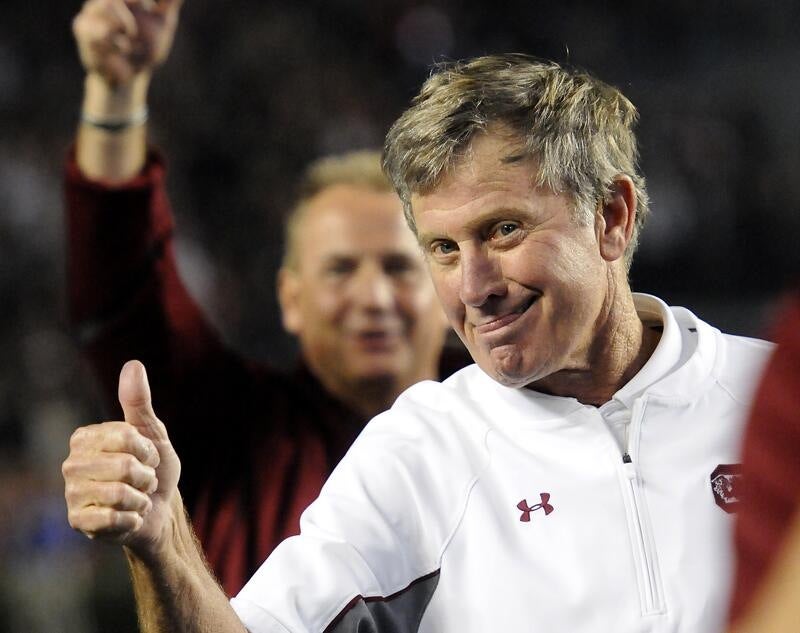
Steve Spurrier and His Influence...on ME...

With all the stuff out about Steve Spurrier here recently, and how folks are finally seeing just what a good coach he his, despite his witty wisecracks, and penchant for running up the score, I thought I'd share just what an influence the Head Ball Coach has been on my coaching style.  I'm in the middle of season, so this won't be a post with a bunch of "bells and whistles" like many of my others.  Nope, this will just be a "quickie" so to speak (lol).

Spurrier, was the first head coach I idolized.  So much so, I still wear a visor on game day to this very day.  So much so, I once named a favorite trick play "Spurrier", because much like who he was named after, it was a thorn in our opponent's sides.  I grew up, and am still to this day a die-hard University of By-God Florida Gator fan, and when I was coming into my own with football, Steve Spurrier was just getting going at UF.  I watched many a Saturday where the ol' HBC (by the way, for you guys that say it's "Ol' Ball Coach, it's not.  It is, has and always will be the HEAD BALL COACH!!!) would turn a football game into a 7 on 7 version of a track meet.  I was always in awe of just how open his receivers would be.  I was also in awe at how he took meager quarterbacks and made them look like world beaters, and in some cases even Heisman Trophy contenders.  No doubt, the HBC was my guy, and if I ever became a coach I wanted to be just like him.

Link: Good article from Coach Hoover on Spurrier's offense with link to playbook.

Early Coaching Influences
Spurrier's knack for rubbing people the wrong way was probably the first talent I developed as a coach, however, I was long before classified as an "asshole" before I even started coaching.  Hey, it is what it is.  I get my point across and you know where you stand with me.  The HBC is no different.  He tells it like it is, even if that means rubbing somebody the wrong way.  At least you know where you stand with him.  I always loved the "You can't spell Citrus without UT" comment.  That is one of my all-time favorite "Spurrier-sim".  Anyhow, my first coaching gig was a youth league deal where I lived.  Folks there knew I had played/coached in college and were in need of coaches, so I took the deal.  It worked out with my work schedule, and though I had just finished up coaching 17-22 year-olds, I thought "What the heck?", how hard can it be right?!  Well, I was in for a big learning session that year, but my lack of words to folks who weren't getting the job done wasn't every a problem.  I mean, I feel, if you're given a task, whether it be volunteering or whatever, do it the best you can do it, and don't screw it up.  If you do, I'm going to tell you about it, because I want you to feel uncomfortable about what you just did, so you don't do it the next time.  That flew about like a lead brick in my new HC gig, but like I said, folks knew where they stood with me and they knew what I wanted and expected out of them.  Much the same is with Spurrier.  He tells it like it is, and if that doesn't sit well, you can pack it up and move on, or buckle down and do your job (just ask Ron Zook).  That's what I really like about the man, is that it's either black or white, there is no gray.  You either do your job right, or you don't.  When you do your job, you get praised, when you don't, you're told about it in a manner that makes you feel pretty uncomfortable.  I'm cool with that, and once most people get over the initial shock of "Did he really just say that?", they are cool with it too.


Another item I took from Spurrier's playbook, was not only making some folks uncomfortable, but making opposing defenses uncomfortable, and doing so in what was considered an unconventional method.  When I got into this youth league I watched some film of the previous year, and the craziest thing out there was some single-wing!  Most teams were I, or split backs running isolation, power, sweep etc.  Well, not this guy!  I came in and we installed our version of the "Fun-n-Gun" offense.  We ran out of the "I", but the lead draw was our base play.  Just like the HBC, that was our playaction on every pass play.  Now don't get me wrong, we ran some dive, trap, toss sweep and a nifty counter toss-sweep (also from Spurrier), but the lead draw was our staple.  The more and more we played the more I recognized that nobody was spreading the field much.  Well, in my second year there, we started to open it up a bit more.  We played a lot of 11 personnel and went into the shotgun.  I remember folks saying "You can't throw the ball that much here and win.", or "That won't work here.".  Well it did, to the tune of a 1-9 team going to 5-3 the next two seasons.

I used to have opposing coaches come up and say "How do you get that kid to shotgun snap at such a young age?".  To which I'd just chuckle and say "You gotta rep it coach.".  So many of these guys were stuck in their ways that thinking outside the box just didn't happen.  I'm glad I had a guy like Spurrier, who's whole career as a football coach has been defined as thinking outside of convention.  Another thing we did was to run the read option early on, which nobody was doing, and barely anyone was doing even in college football.  I had installed a zone blocking scheme for our OL when I came in, and one day when we ran our lead play out of the gun, my QB said "that end is crashing real hard coach, why don't you ever let me keep it?".  I asked him, if he thought he could read that end, and make a decision and he quickly replied with a "Yes!".  So we ran the zone read before zone read was en-vogue!  I also ran jet sweep before Wes-Elrod made his living writing books and opening up www.jetsweep.com (mostly because I actually coached against Wes in college and had seen it, and liked what I saw and what the jet sweep did to defenses).  Again, all this leads me back to my Spurrier roots, because it was things that nobody else around was doing, and it was things that made opposing defensive coordinators, very, very uncomfortable.


You see, what I relished about Spurrier, and what went along with the situation I was in, was that he and I seem to be at our best when somebody says "you can't do that", or "that won't work here".  I've been getting it all my life, and so has Spurrier.  See, he was a skinny QB, that not many folks really cared about recruiting, yet turned out to be a Heisman trophy winner.  I was the same way, a short squatty offensive lineman, who nobody thought would amount to much, that ended up playing small college football and getting a large portion of my degree payed for.  An offensive lineman who at 5'9" tall, and a whopping 245 pounds started next to a 6'2" 265 pound center, and a 6'5" 315 pound offensive tackle.  The guy's job that I took, was 6'4" and 260 pounds.  That's the stuff I like.  Back me into a corner and tell me I can't.  Tell me it won't work.  I get a lot of that from my dad, but it was honed and sharpened by watching the HBC throw the pigskin around on Saturday afternoons in Gainesville.  Don't tell Spurrier something won't work, he'll make damn sure it does, and then he'll tell you about it!


So when I entered this youth league and wanted to throw the ball all over the place with three and four receiver sets, and run zone read option, folks thought I was an idiot and made their same old statement, "Can't do that here".  The guy that hand signaled in every play to his QB on wristbands, and could go no huddle if he wanted to at any time, was also told "That won't work here coach".  Yep, none of that would've worked had I done what many coaches do, and simply listen to the critics.  What I learned from Spurrier is, they don't matter.  You know what does matter, the guy you look at in the mirror everyday.  That guy matters, and he matters the most.


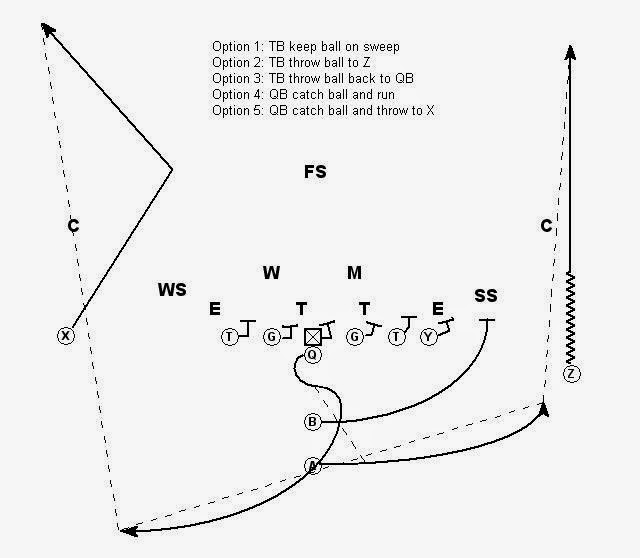
One thing from my early years I must reflect upon because it's actually quite comical is the trick play I referenced above, aptly named after my favorite football coach, "Spurrier".  What it boiled down do is shown below.  Yep, just the old halfback pass, however I added the element of option to it.  The halfback, if everyone dropped off in coverage, could simply turn it into sweep.  However if the corner bit on the sweep, he would toss it to the wide open Z receiver.  If the defense over pursued to the sweep, he could then turn and toss it back to the QB who had run what many would call a bubble route, however we just made sure he was deeper than the RB.  The QB now had the option, had everyone left him alone to turn the ball up and run it.  Now, if the corner had stayed home for the reverse, he had another option, and that was to hit the X receiver on the Sally route, for  a touchdown.  Seems like a lot for youth league right?  Nah, just gotta rep it!  We would run this on air 10 time and live 10 times everyday.  As the season progressed, we could do it less and less to where these kids could do it in their sleep.  I once ran this in a game, six times.  Let that sink in...six times!  I remember their coach yelling "They're running that play again, that trick play, don't get beat deep".  Every time it worked for a first down, or a touchdown.  The opposing coach was so embarrassed, he wouldn't shake my hand after the game.  Hey, sometimes you gotta do what you gotta do!


Later Influences
As time has gone on, and Spurrier's career left the University of Florida, I've kept my eye on him.  I was a bit shocked he didn't turn the NFL on its ear, but the NFL has been a killing ground of innovative coaches.  Say what you want, but even the Chip Kelly's of the world aren't doing EXACTLY what they did when they were in the collegiate game.  They have to modify it some.  Spurrier wasn't going to do that, he was going to do it his way, even if that meant sinking with the ship.  His time in the NFL was rocky, and many folks criticized him, but in reality it was good for him.  See, Spurrier, at UF, was borderline larger than life.  Hell, who am I kidding, in the State of Florida, he's a god.  I think every man needs humbling now and then, and Steve was no different.  I went through the exact same thing, from getting a high school head coaching job, and then getting let go, all of which helped humble me as a coach, because quite frankly before getting the job I was touted as a very good football coach.  So was Spurrier, and many thought the NFL was in for a ride when he came on scene.  However, even one who may be labeled as the best college football coach ever, Nick Saban, couldn't win in the NFL.  It's quite simply, a different game.  I learned this lesson as well, and with tail tucked between my legs, left the high school game, and went back to coaching junior high ball for a humbling two year stint.

Spurrier sat out of coaching for a while too, and once the South Carolina job opened up, he jumped at the chance.  A challenge.  Win, where winning wasn't traditional.  Not to say that Lou Holtz hadn't helped Spurrier a bit, but let's be honest, Holtz's influence has long since vanished from South Carolina.  When Spurrier stepped back in the ring, you could easily tell he wasn't the same snippy coach.  No, he seemed on a mission, and that's exactly what he's been on.  The more and more he's been successful, the wittier he's gotten, until now, he's back to the old Spurrier.  I have faced just such a thing myself, and watching him go through it has shown that being humbled is not a bad thing.  In fact, it is quite the opposite.  Being humbled really has helped me as a coach.  I've learned not everyone needs to be told exactly what you're thinking all the time.  Choose your words and pick your battles.  What I've also learned is to be adaptive.  Adapt to what you have, make it fit your players, work through kinks etc.  Spurrier has done this too.  His offenses at South Carolina, though they still have some of the old flair to them of the "Fun-n'-Gun", they aren't the same offense.  Spurrier has learned to adapt, use the running QB, go no huddle, and yes, by gosh, run the ball when you have to.  Yep, I'd say he's come a long way from the pass-happy Fun-n-Gun.  Many say he's an innovator, and no doubt he's changed the game, but he's also proved, that he'll do whatever it takes to win.

One of the biggest contributions I got from the HBC, was that he not only does it his way, he does it the right way.  You rarely hear of any of his teams getting busted for violations.  Now, I know, he's like every other coach, and has players that end up having brushes with the law, but to be honest, everywhere Spurrier has been he's run a clean program.  Bobby Bowden, Urban Meyer, Jimmy Johnson and the lot cannot attest to having the same track record.  Sure, they've won more championships, but at what cost?  Spurrier is the benchmark of what a clean program should look like.

You won't see this heading anywhere near a Spurrier run program!
 
What I've really picked up from Spurrier though is the fact that football doesn't need to consume your life.  For me, when football season rolled around, everyone knew, I was going to disappear.  When I was the head coach, it was football 24-7.  So much so, that when I got canned, I looked around and realized "Where the hell did the last six years of my life go?".  Sure, we had won games, been successful and then slowly slid downhill after that to the point of me getting let go, but what had I missed?  In the process I had missed my great grandmother's 98th birthday, two cousins weddings, several family members being born, and being an avid hunter, just about every deer season the past 14 years has been pretty uneventful!  I remember when it was all over, just feeling so damn lost because football wasn't in my life.  I think we all would feel that, and even the HBC would admit to being that way too, however, he could've been just as content playing golf somewhere.  Spurrier took time off from the game and it rejuvenated him, as it did me.  I went and helped a friend coach a struggling junior high team, and to be honest that may have been the best two years of my coaching career.  Not in terms of wins or losses, but in terms of what I learned.  It's a game, have fun with it.  Have fun with the kids, that's what they are out there for, why not have fun with them?  I did just this for two seasons, and then the call came for me to come back to the high school ranks as a defensive coordinator.  Two years off, and I was rejuvenated and ready to work.  Ready to get back to the grind.  Well, three games into last season, giving up over 400 yards of total offense per game and sitting at 0-3, I realized I had become the same man I was before my firing.  Three hours of sleep, no patience, being snippy and actually dreading going to practice had become the norm again.  Thank God I have a head coach that had the intestinal fortitude to see this, and say "stop it".  Let's go super simple, learn our assignments and get the kids playing faster.  Well, we did just that.  I went to bed at ten every night.  Scheme was super simple, no more crazy hours worked.  As the year went on, I began to have more and more fun with it. We turned things around, and although we weren't good on defense, we made the playoffs for the first time since 07'.


I was going to resign at the end of the season, but something has kept me going.  I told myself this season, I'm going to do what I did for two years with the junior high program...have fun.  So far I am.  It has been a bit stressful, and I do still grind some, but not like I used to.  I get up and go hunting every Friday morning before the game.  I go out on dates with my wife during game week, and most importantly I don't yell anymore to get my point across, I coach, correct, smile and have fun.  What does this have do with Spurrier?  Well, it's really how he's always done things.  He's never been a grinder, and look at the success he's had.  I figure if he can do it, anyone can, and I'm going to give it a try!  So far, I'm loving it.


Football is a wonderful game, but it's the people involved with it, that make it really special.  I have missed that.  I look back on some of the good teams I coached, and even though I had a relationship with my players, it was more like a business relationship than a coach-player relationship.  I have definitely changed in my approach to how I relate to my players.  I make sure to ask them, how they are doing, what is going on in school and at home.  Where I used to walk out of the locker room and go home at the end of the day without speaking to one player, I try to stop and talk to all of them.  Lastly, something I didn't get from Steven Spurrier, but from another mentor of mine, is always stop and look a player in the eye and shake his hand when asking him how his day went.  That little piece of advice has really helped me bridge the gap from lab rat defensive coordinator to "coach".  Sure I'm still blunt in the way I correct guys, but at the end of the day they know I have their back, and they know our relationship is more than just business.  You know, in many ways, Spurrier is the same way.  This is the guy that has suggested coaches assist in paying players so that they would have a "piece of the pie" of the money that college football rakes in every year.  He cares about the players, even though he may not always show it, or have a funny way of showing it.  Whether you like him or not, there's an awful lot there to respect.  I think even ol' Bobby Bowden would agree to that (dadgummit)!!!


Anyhow, just something I thought I'd share with you.  I didn't really know how big an impact Spurrier had on me, until I began reading the articles about him.  I think he's a remarkable coach, and I hope he still has a lot of years left in his tank.  I think Steve Spurrier is good for college football.  I think college football would agree...

Duece